
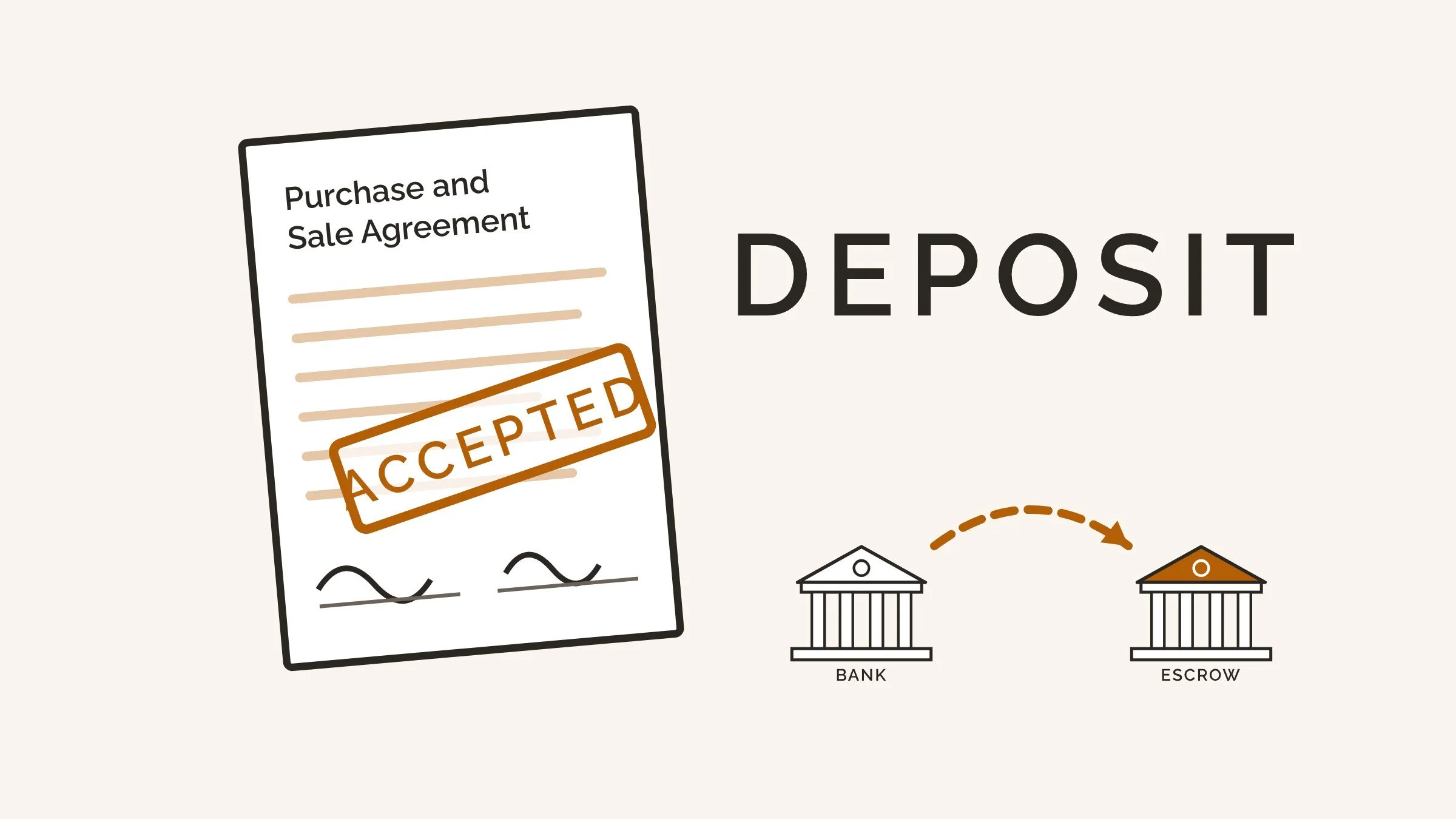
Short answer: due within 2 business days of mutual contract and is held by the closing agent.
Real answer: Earnest money is the buyer’s deposit once an offer is accepted. In the Seattle area it’s usually 1 to 5% of the price, and 2 to 3% on average. Under Washington’s standard purchase contract (NWMLS Form 21) it’s due 2 business days after mutual acceptance unless the contract says otherwise. It goes to escrow or the buyer’s brokerage, never straight to the seller. At closing it counts toward the price. If the deal ends early, the contract decides who gets it.
Earnest money planner
How much, when it’s due, where it sits, and what it does at closing
Tap what fits and enter your numbers. The due date counts Washington’s holidays the way Form 21 does. Nothing you enter leaves this page.
Where the amount sits
Your deadline, day by day
At closing
Your next steps
A planning aid, not legal advice. Rules from NWMLS Form 21 (Rev. 2/26) General Terms a, b, l and o; RCW 1.16.050, 18.44.400, 18.85.285, 18.85.311 and 64.04.005; Fannie Mae Selling Guide B3-4.3-09. Your contract and addenda control; deadlines run to 9:00 p.m. Pacific. Closing costs are not shown. For your situation, talk to a real estate attorney.
Every offer I write has a dollar amount on line 7 of Form 21, and every accepted one starts a two-day clock. The questions come in the same order: how much, when it’s due, how to send it, and whether it’s on top of the down payment. It isn’t. It’s the first piece of the price, paid early.
Same thing, other names: earnest money deposit (EMD), good faith deposit, escrow deposit, or simply the deposit on a house. Washington’s contracts call it Earnest Money.
The basics
What earnest money is, and what it isn’t
Earnest money is part of the purchase price, paid early. Form 21 says the buyer pays the price, “including the Earnest Money,” at closing. It tells the seller the buyer is serious enough to put real money behind the offer while the home comes off the market.
It isn’t a fee, and it isn’t extra cash on top of the down payment. It’s held by a neutral party, usually the escrow company named in the contract, and it sits there until one of three things happens.
- 1Closing: Credited toward the price; most deals end here
- 2Contingency exit: Refunded to the buyer under the contract’s terms
- 3Buyer default: The seller keeps it, up to 5% under the forfeiture box
How much
How much earnest money is normal in Seattle
In the Seattle area, earnest money usually runs 1 to 5% of the price, and 2 to 3% is about average. On a $1.35 million home that’s $27,000 to $40,500 for the middle of the range. A larger deposit makes a stronger offer, because it shows more commitment.
Earnest money on a $1,350,000 home
No minimum, but a 5% ceiling
There’s no legal minimum. Form 21 leaves the amount blank, so $500 is allowed, but at Seattle prices it reads as a rounding error to a seller comparing offers. The top of the usual range lines up with the law. Under the standard forfeiture box, a seller can keep no more than 5% of the price if the buyer defaults (RCW 64.04.005).
Two details people miss
Earnest money is a dollar amount. If an escalation clause pushes the price up, the deposit stays what the contract says unless the parties change it. Lenders look at it too. Fannie Mae’s rules say deposits larger than customary for the area should be closely evaluated. Your lender will want to see where the money came from.
How much to put up in a particular offer is deal strategy. So are the advanced moves some buyers make in competitive months, such as releasing part of the deposit to the seller early. They aren’t the norm, and I plan them home by home with clients: buyer guide, offers and seller guide, offers.
Deadline
When earnest money is due in Washington, counted the right way
Timeframe 2 business days after mutual acceptance, unless the contract says otherwise
The contract sets a Delivery Date: a number of days after mutual acceptance, written next to the amount in Specific Term 7. Leave it blank and it’s 2 days. Mutual acceptance is day 0; day 1 is the next day.
How the days are counted
Form 21’s computation-of-time rule does the rest. Any period of 5 days or less skips Saturdays, Sundays and Washington legal holidays, so a 2-day deadline is really 2 business days. Longer periods count calendar days and roll forward if the last one lands on a weekend or holiday. Deadlines run to 9:00 p.m. But the money has to arrive, not just be sent. If it goes by mail, it must reach the holder by the Delivery Date.
A 2-day deadline over Thanksgiving
If the deadline is at risk
Missing it is a breach of the contract. Sometimes a bank holds a wire for review on deadline day. The fix is a signed extension before the deadline passes, not an apology after it. I have buyers start the wire the business day before it’s due.
Paying it
How to pay earnest money: wire, cashier’s check or personal check
The escrow company decides what it accepts, so ask when you get its instructions. A wire is fastest and counts as soon as it lands. Many escrow offices still take a personal check or a mobile deposit for earnest money when closing is weeks away.
Wire
Counts when it lands. Confirm instructions by phone first; banks have cutoffs and daily limits.Cashier’s check
Treated as cleared once the issuing bank pays it.Personal check
Often fine for earnest money on a longer closing; never for closing funds.Good funds: money has to clear
The catch is Washington’s good funds law (RCW 18.44.400): escrow can’t pay out money until it has actually cleared. A personal check that hasn’t cleared can’t close. Fidelity National Title’s Seattle guide notes a cashier’s check can take up to two business days to clear. It also notes ACH transfers can be recalled. On a short closing, wire it.

Liquid money, and wire fraud
Whatever the method, the money must be liquid on deadline day. That means cash in an account, not stocks, a CD or a 401(k) you still have to sell or borrow from. Wire fraud is the real risk here. What to do once your offer is accepted walks through confirming wire instructions at a number you already trust.
Where it sits
Who holds earnest money in Washington, and does it earn interest
Form 21 gives three choices in Specific Term 7. They are the Closing Agent (the escrow company), the Buyer Brokerage Firm, or a promissory note attached as an addendum. The seller never holds it.
The usual choice
Escrow company
- Separate escrow trust account
- Deposited by the next banking day
- No interest terms in Form 21
Less common
Buyer’s brokerage
- Over $10,000 with a W-9: interest to the buyer
- $10,000 or less: Housing Trust Fund pool
- Moved to escrow at closing
Rare
Promissory note
- A promise, not money
- Attached as an addendum
- Paid when the note says
Held by escrow
Escrow is the usual pick. Licensed escrow agents keep client money in separate trust accounts and deposit it by the next banking day (RCW 18.44.400). Form 21 sets no interest terms for money escrow holds.
Held by a brokerage
When a brokerage holds it, the amount decides where it sits. Over $10,000, it goes into an interest-bearing trust account in the brokerage’s name once the buyer signs an IRS Form W-9. The interest, after bank fees, goes to the buyer. At $10,000 or less, or without a W-9, it goes into a pooled Housing Trust Fund account. Then the interest goes to the state: 75% to the housing trust fund and 25% to real estate education (RCW 18.85.285 and 18.85.311). The brokerage moves it to escrow at closing.
A promissory note
A promissory note is a written promise to pay, not money in hand. Washington law counts it as earnest money (RCW 64.04.005), and the note itself says when it must be paid.
Selling
Selling: what the buyer’s earnest money tells you, and what to check
When you accept an offer, the earnest money is the first promise you can verify. Form 21 tells the closing agent to send written verification of receipt, and notice of any dishonored check, to both sides and both brokers. If no receipt has arrived by the Delivery Date, your broker should be asking why.
Specific Term 7
Amount, holder and Delivery Date
The receipt
From the holder, by the Delivery Date
Specific Term 8
Forfeiture or Seller’s Election of Remedies
Open contingencies
Each one is a refund door until it closes
Where the deposit goes
The deposit doesn’t land in your account. It sits in trust and is credited toward the buyer’s price at closing. If the buyer leaves through an open contingency, it usually goes back to them. You only keep it if the buyer defaults, and then only what Specific Term 8 allows: up to 5% under the forfeiture box. The rest of that story, including releases and the 20-day demand clock, is in what happens if a buyer backs out.
Closing
At closing: earnest money counts toward your down payment
Escrow adds up everything you owe at closing (down payment, closing costs, prepaid items). It subtracts the earnest money already in its account and asks you to wire the rest. Your settlement statement shows the deposit as a credit; it’s worth finding that line before you sign.
$270,000 down payment on a $1,350,000 home
What your lender checks
Fannie Mae, whose rules most conventional loans follow, accepts earnest money toward both the down payment and closing costs. The lender verifies it with a canceled check or a statement from the holder. It also wants two months of statements showing the money was yours. So don’t move it around right before you write the offer.
If it ends early
If the deal ends early: who gets the earnest money
Most deals close, and the deposit simply becomes part of the price. When one doesn’t, the reason decides the answer. A buyer who leaves through a contingency still in force (inspection, financing, the seller disclosure, the sale of their own home) gets it back. A buyer who simply walks away after every exit has closed is in default, and the seller keeps what Specific Term 8 allows.
How it gets released
Either way, escrow won’t release it on one person’s word. It needs both signatures on a release, or the written-demand process in RCW 64.04.220. Each piece has its own page: a buyer backing out, the financing contingency and a low appraisal.
FAQ
Frequently asked questions about earnest money in Washington
How much earnest money is typical in Seattle?
Usually 1 to 5% of the price, and 2 to 3% on average. On a $1.35 million home, 2% is $27,000.
When is earnest money due in Washington?
On the Delivery Date in Form 21’s Specific Term 7, or 2 days after mutual acceptance if it’s blank. Periods of 5 days or less skip weekends and Washington legal holidays, so 2 days means 2 business days.
Is earnest money part of the down payment?
Yes. It’s part of the purchase price paid early, and escrow credits it at closing toward your down payment and closing costs. You wire the rest.
Who holds earnest money in Washington?
Usually the escrow company named in the contract. Form 21 also allows the buyer’s brokerage or a promissory note. Never the seller.
Is earnest money refundable?
When the buyer leaves through a contingency that’s still in force, yes. When the buyer defaults after the contingencies are gone, the seller can keep up to 5% of the price under the forfeiture box. Details: what happens if a buyer backs out.
Is $500 enough earnest money?
It’s legal, since there’s no minimum, but at Seattle prices a seller comparing offers will read it as weak. Most deposits here are 1 to 5% of the price.
Is 10% earnest money normal?
Not in Washington’s standard deals. Under the forfeiture box a seller can keep no more than 5% of the price, and lenders look hard at deposits above what’s customary.
Can I pay earnest money with a personal check?
Often, if escrow accepts it and closing is far enough away for the check to clear. A wire is the safe choice on a short closing.
Does earnest money earn interest?
Only when a brokerage holds more than $10,000 and you sign a W-9; then the interest, after bank fees, is yours. Smaller brokerage deposits earn interest for the state housing trust fund. Form 21 sets no interest terms for escrow.
What happens if I miss the earnest money deadline?
It’s a breach of the contract. If a bank delay is coming, get a signed extension from the seller before the deadline passes.
Do cash buyers pay earnest money?
Yes. Paying cash removes the loan, not the deposit. See how to make a cash offer.
The bottom line
Earnest money is the first piece of the price, paid early, held by a neutral party, and credited back at closing. In the Seattle area it’s usually 1 to 5% of the price, due in 2 business days unless the contract says otherwise. If the deal ends early, the contract’s contingencies and default box decide where it goes.
Sellers: look for the receipt. Buyers: have the money liquid before you offer, and send it a day early.
Next steps by topic: after your offer is accepted, if a buyer backs out, financing contingency, proof of funds, Washington vs other states.
Sources
- Form 21, Residential Purchase and Sale Agreement, Rev. 2/26 (Specific Terms 7 and 8; General Terms a, b, l, o, q), Northwest Multiple Listing Service (sample packet)
- RCW 64.04.005, liquidated damages and earnest money deposits, Washington State Legislature
- RCW 1.16.050, legal holidays, Washington State Legislature
- RCW 18.85.285, real estate trust accounts, Washington State Legislature
- RCW 18.85.311, distribution of interest from brokers’ trust accounts, Washington State Legislature
- WAC 308-124E-110, funds held in trust, Washington State Legislature
- RCW 18.44.400, escrow agent accounts and good funds, Washington State Legislature
- Selling Guide B3-4.3-09, Earnest Money Deposit, Fannie Mae
- Escrow Deposits: Good Funds for Escrow Closing, Fidelity National Title, Seattle
- Earnest money ranges (1 to 5%, 2 to 3% average), Brian Huie, Compass, transaction experience