
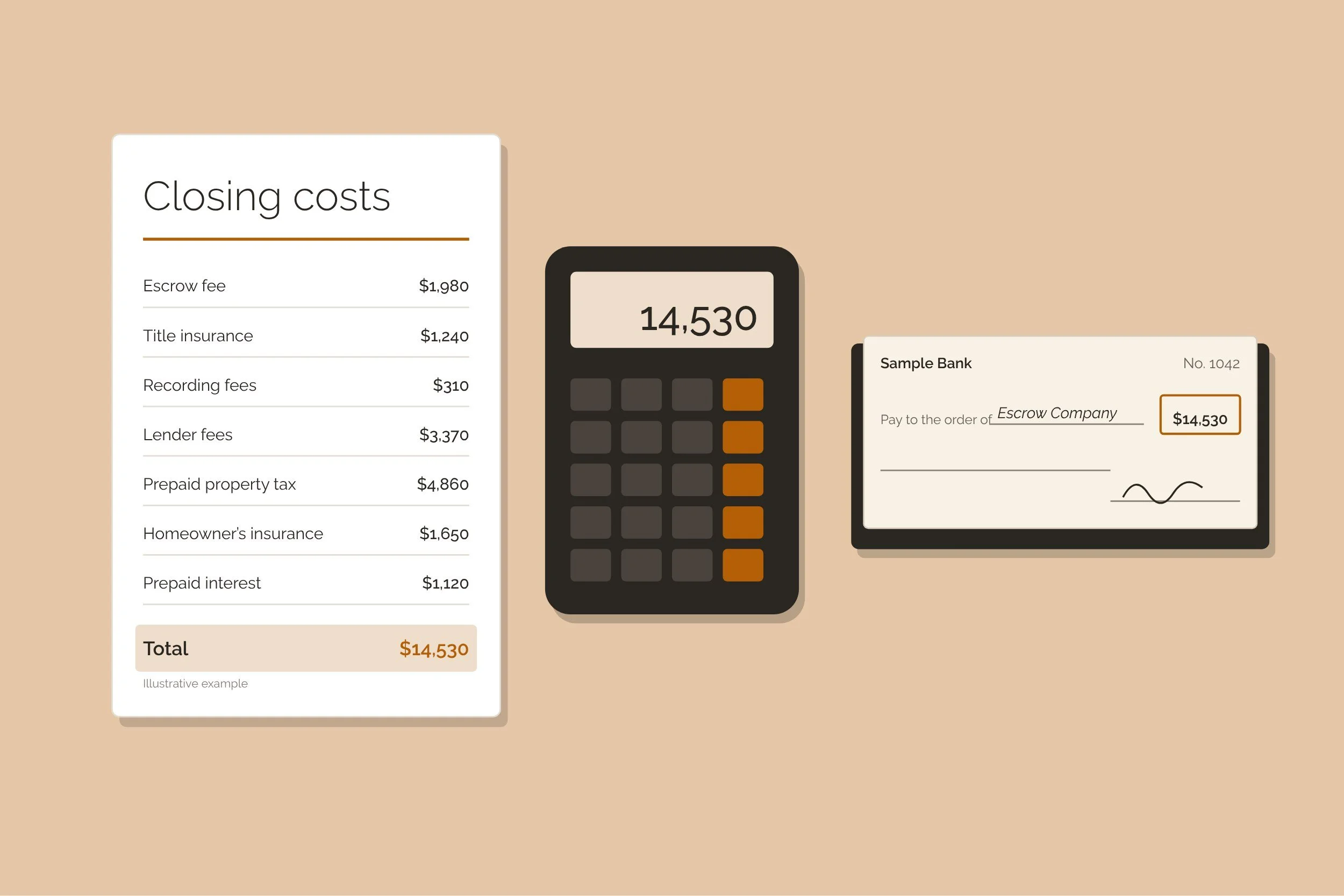
Short answer: about $3,000 to $6,000 with cash on a $1M to $2M home, and about 1.4% of the price with a loan.
Real answer: I went through 74 of my buyers’ settlement statements from 2023 to 2026. The fees barely change with price. The property tax share grows with it, and the closing month swings it. Buyers with a loan paid about 1.2% to 1.6% of the price, before points or a rate buydown. Most of that money is not a fee at all. It is property tax, interest and insurance paid ahead.
From my 74 statements, 2023 to 2026. Same thing, other names: buyer closing costs, settlement costs, funds to close, or the buyer’s side of the settlement statement. “Cash to close” is close, but it also counts the down payment.
Two numbers get mixed up. “Closing costs” are the fees and prepaid items. “Cash to close” is closing costs plus your down payment, minus your earnest money and any credits. Ask for both.
Estimate your closing costs
Built from 74 of my buyers’ settlement statements (2023 to 2026). Tap or type; the answer updates at once.
- Ask your lender for the Loan Estimate and, 3 business days before closing, the Closing Disclosure. Compare them line by line.
- Ask escrow for your final cash-to-close figure and wire instructions, then call escrow at a number you already trust to confirm them.
- Ask whether your closing month means a tax payment or a credit at closing.
An estimate from my medians, rounded to $50. Your lender’s Loan Estimate and escrow’s statement are the real numbers. What to do about these costs, including credits and rate choices, is in my buyers guide.
Run the tool twice: once at your top price and once with the seller credit you plan to ask for. The gap is your negotiating room.
What 74 Seattle-area buyers actually paid
I pulled every buyer-side settlement statement in my files from January 2023 to November 2026: 74 closings, 65 with a loan and 9 with cash. Most are in Seattle. The rest are in King, Snohomish and Pierce County. Prices ran from $300,000 to $2,550,000.
I split every buyer charge into 3 buckets. That makes the numbers fair to compare.
Typical ranges, middle half of my statements
| Bucket | Cash buyers (9) | Buyers with a loan (65) |
|---|---|---|
| Closing costs (fees) | $1,900 to $2,050 (median $2,024) | $2,300 to $2,600 (median $2,423) |
| Prorations and prepaids | $200 to $1,450 (median $1,142) | $4,900 to $8,150 (median $6,662) |
| Lender charges | $0 | $3,100 to $4,050 (median $3,368) |
| Total | $2,300 to $3,500 (0.25% to 0.59% of price) | $11,000 to $15,400 (1.23% to 1.63% of price) |
Totals leave out points and rate buydowns. Each column’s total is its own middle half, so the rows do not add up exactly.
Cash buyers in the $1M to $2M range
Cash fees stay near $2,000 at every price. The property tax share grows with the price. Here is what my cash statements predict:
| Price | Typical (median) | Middle half |
|---|---|---|
| $1,000,000 | about $3,300 | about $2,200 to $5,300 |
| $1,500,000 | about $4,000 | about $2,300 to $7,000 |
| $2,000,000 | about $4,600 | about $2,400 to $8,600 |
So plan for about $3,000 to $6,000. Plan for more if you close right after a tax payment.
The full spread, points and seller credits
- The full spread: the lowest loan total was 0.86% of the price and the highest was 4.97%, both before points. The cash range ran from $831 to $3,943.
- Points and buydowns: 30 of the 65 loan buyers (46%) also paid for a lower rate. With those included, the median loan total rises to 1.62%. The top was 8.4%, on a new build where the builder’s $50,000 credit paid for the rate.
- Seller credits: 28 of the 74 statements show a seller credit to the buyer. The median credit was $10,000.
How I counted. I used final statements. I used 3 estimated statements only where no final exists. Earnest money and the down payment are not closing costs, so they are out. I left out a few items that are not closing costs: a lender’s repair holdback, a contractor invoice and payoffs of the buyer’s own debts. Statements from outside the Seattle area, duplicates and seller-only statements are out too.
The prorations bucket swings the most. It depends on your closing month and on the home’s tax bill, not on anyone’s fees. A low-fee closing can still need a big wire.
Every charge on a Washington buyer’s statement, in plain words
In Washington, the standard purchase contract decides most of who pays what. NWMLS Form 21 splits the escrow fee in half. The buyer pays the buyer’s loan costs, including the credit report, appraisal and lender’s title insurance. The seller pays for the owner’s title policy. (NWMLS Form 21, General Terms e and h)
- Escrow and title about $2,000 goes to escrow company and title insurer
- County and state about $400 goes to recording and the $80 state fee
- Tax share about $1,750 goes to the seller, as a refund, or the county
- Insurance about $1,300 goes to your insurer
- Interest and reserves about $7,050 goes to the lender and your escrow account
- Lender charges about $3,400 goes to the lender, appraiser and lender’s title
Closing costs (fees)
| Charge | Who gets it, and why | Who usually pays in WA | What drives the amount | On my 2025 and 2026 statements |
|---|---|---|---|---|
| Escrow fee | The escrow company, for holding the money and closing the deal | Split 50/50 (Form 21) | The escrow company’s rate sheet and the price | Buyer’s half: median about $1,550 |
| Sales tax on escrow | Washington Department of Revenue. Escrow services are retail sales here (WAC 458-20-156) | Each side, on its own half | The local sales tax rate | About $70 to $225 |
| Recording fees | The county, to put the deed (and the loan’s deed of trust) on public record | Buyer | County fee schedule, per document (King County Recorder) | Deed $303.50 to $308.50; deed of trust $324.50 to $335.50 |
| Foreclosure prevention fee | Washington’s Foreclosure Fairness Account | Buyer, on each home loan | Flat $80 by state law (RCW 61.24.157, via DocMagic summary) | $80 on loan closings since mid-2025 |
| Notary or signing fee | A mobile or remote notary | Each side pays its own | Who signs where, and how many trips | About $100 to $200 |
| Courier, wire and e-recording | The escrow or title company | Buyer | Company fee schedule | About $10 to $95 |
| Excise tax (REET) | State and local government | Seller. State law makes it the seller’s obligation (RCW 82.45.080) | Price tiers | $0 for every buyer in my files |
| Owner’s title insurance | The title insurer, to protect the owner’s title | Seller (Form 21) | Price | $0 for buyers, unless they upgrade to extended coverage (Form 22D) |
| HOA transfer, resale certificate, capital contribution | The HOA or its manager | Resale certificate: seller. Transfer fee: as the HOA documents say, or as Form 22D says | HOA rules. A resale certificate costs at most $275 under WUCIOA (RCW 64.90.640) | Buyer move-in or capital fees of $100 to $500 on condos |
| Septic program fee | Public Health, Seattle and King County | Buyer, at transfer (King County septic sales page) | King County Board of Health fee schedule | $40 |
Prorations and prepaids
| Charge | Who gets it, and why | Who usually pays | What drives the amount |
|---|---|---|---|
| Property-tax proration | Usually the seller, as a refund for taxes they paid ahead. King County bills in two halves, due April 30 and October 31 (King County Treasury) | Split by the day of closing (Form 21) | Tax bill and closing date. Close in spring before the April payment and the seller may credit you instead |
| HOA dues proration | The seller, for dues they paid ahead | Split by the day | Monthly dues |
| Prepaid interest | The lender, for interest from closing to the end of that month | Buyer with a loan | Loan size, rate and closing day. Close late in the month and this line is small |
| First-year homeowner’s insurance | Your insurer | Buyer | The policy. Median about $1,300 on my 2025 and 2026 statements |
| Escrow reserves (impounds) | Your loan’s escrow account, for future tax and insurance bills | Buyer with an escrow account | Federal rules let the lender keep a cushion of up to 2 months (CFPB, Regulation X). The closing month sets how many months are collected |
| Aggregate adjustment | A credit back to you that trims the reserves to the legal limit | Credit to buyer | Lender’s escrow math |
Lender charges (loan only)
| Charge | Who gets it, and why | What drives the amount | On my 2025 and 2026 statements |
|---|---|---|---|
| Origination, underwriting, processing | The lender, for making the loan | Lender pricing; some charge a % of the loan | Underwriting $795 to $1,495 |
| Mortgage broker fee | A broker who shops the loan for you | Usually a % of the loan; often offset by a lender credit | 3 statements, $5,600 to $11,046 |
| Appraisal | The appraiser | Home type and size | $750 to $1,100, often paid before closing |
| Credit report, verification, tax service, flood check | Outside vendors the lender hires | Vendor prices | Credit report $94 to $422; flood check $5 to $10 |
| Lender’s title insurance | The title insurer, to protect the lender | Loan amount | Median about $990, plus sales tax on some statements |
| Upfront mortgage insurance (FHA) | HUD | 1.75% of the base loan on FHA loans (HUD Mortgagee Letter 2012-04) | 1 FHA statement |
Your Loan Estimate lists these same lines in the same order as the Closing Disclosure. Lay the two side by side 3 days before closing and circle anything new.
Optional and extra costs
These do not show up on every statement. Some are your choice. Some show up only when something changes.
More cash today
Lower payment for the life of the loan
The lender’s base price
The quoted rate
Less cash today
Higher payment for the life of the loan
| Cost | What it is | Who usually pays | On my statements |
|---|---|---|---|
| Points (permanent buydown) | You pay the lender at closing. You get a lower rate for the life of the loan. One point is usually 1% of the loan (CFPB) | Buyer, or seller through a credit | 30 of 65 loan buyers paid points or a buydown |
| Temporary 2-1 buydown | Money at closing lowers your payment for 2 years: 2% lower in year 1, 1% lower in year 2. Fannie Mae sets no dollar cap, but seller-paid buydowns count toward its credit limits (Fannie Mae B2-1.4-04) | Often the seller or builder | $4,250 to $22,500 on my statements |
| Lender credit | The reverse of points. You take a higher rate and the lender pays some costs (CFPB) | Lender | $87 to $9,330 |
| Seller credit (concession) | The seller pays some of your costs. Conventional caps: 3% of the price under 10% down. 6% with 10% to 25% down. 9% with 25% or more (Fannie Mae B3-4.1-02) | Seller | 28 of 74 statements; median $10,000 |
| Home warranty | A one-year service plan on systems and appliances | Buyer or seller, as agreed | $400 to $639 when paid at closing |
| Inspections | Home, sewer scope, roof and others. Usually paid before closing, so they rarely show on the statement | Buyer | Not on most statements. My buyers guide lists typical ranges |
| Rate-lock extension | The lender’s fee to hold your rate past the lock date | Buyer, unless the delay is someone else’s | $1,899 on one 2023 statement |
| Mobile or remote notary | A notary comes to you, or signs you on video | Each side pays its own | About $95 to $250 |
| Wire, courier and delivery | Escrow’s cost to move money and papers | Buyer | About $10 to $95 |
| Buyer-paid broker pay | Your broker’s pay, when the seller does not pay it | Set in your buyer agreement | 2 of 74 statements, $225 and $2,000 |
Ask your lender for 3 quotes on the same day: with points, with no points, and with a lender credit. Then do the math on how long you plan to keep the loan.
Cash vs a loan: what a cash buyer skips
Cash removes the loan, and every charge that comes with it. It does not remove escrow, recording or the tax share.
| Line on the statement | Cash | Loan |
|---|---|---|
| Buyer’s half of the escrow fee, plus sales tax | Yes | Yes |
| Deed recording | Yes | Yes |
| Deed of trust recording | No | Yes |
| $80 foreclosure prevention fee | No | Yes |
| Property-tax and HOA prorations | Yes | Yes |
| Prepaid interest | No | Yes |
| First-year insurance at closing | Usually paid directly to the insurer | Yes |
| Escrow reserves for tax and insurance | No | Usually |
| Lender, appraisal and credit fees | No | Yes |
| Lender’s title insurance | No | Yes |
| Points or buydown | No | Optional |
On a $1,350,000 home with 20% down, my medians come to about $2,000 in fees and $1,750 in tax share with cash. With a loan they come to about $2,400 in fees, $10,100 in prorations and prepaids, and $3,400 in lender charges. That is about $3,800 with cash and about $15,900 with a loan.
The prorations gap is mostly money you would pay anyway: prepaid interest, a year of insurance and a cushion for your tax bill. A cash buyer pays the same insurance and taxes. The bills just come later. For how a cash offer works, see my post on how to make a cash offer.
Even with cash, budget for the tax share. A spring closing can mean paying the whole first half at closing, then getting a credit back for the seller’s days.
Frequently asked questions about buyer closing costs in Washington
How much are buyer closing costs in Washington State?
On my 74 Seattle-area statements, buyers with a loan paid about 1.2% to 1.6% of the price, before points. Cash buyers paid about $3,000 to $6,000 on a $1M to $2M home.
Who pays closing costs in Washington, the buyer or the seller?
Both. Under the standard NWMLS contract, the escrow fee is split in half. The seller pays the excise tax and the owner’s title policy. The buyer pays recording and all loan costs.
What are buyer closing costs when paying cash?
The buyer’s half of escrow, deed recording, a notary and the tax and HOA share for the closing month. Cash skips every lender charge.
Is “cash to close” the same as closing costs?
No. Cash to close adds your down payment, then takes off your earnest money and any credits.
Does the buyer pay excise tax in Washington?
Not on a normal sale. State law makes the real estate excise tax the seller’s obligation.
Can the seller pay my closing costs?
Yes, through a seller credit written into the offer. Your loan type caps it. On a conventional loan the cap is 3%, 6% or 9% of the price, set by your down payment.
Why did my closing costs come in higher than the estimate?
Usually the closing date moved. The date changes the tax share, the prepaid interest and the months of escrow reserves.
The bottom line
Plan on about $2,000 to $2,600 in fees at any price. Then add your share of the property tax for the closing month. With a loan, add about $3,100 to $4,050 in lender charges, plus interest, insurance and reserves paid ahead. On a $1M to $2M home, that is about $3,000 to $6,000 with cash and about 1.2% to 1.6% of the price with a loan.
My buyers guide covers what to do about it: when to ask for a credit, how to compare lenders and when to wire. Read the Costs chapter.
Sources
- My 74 buyer-side settlement statements, January 2023 to November 2026 (private; client details removed)
- NWMLS Form 21, Rev. 2/26 sample packet, General Terms e and h; Form 22D
- RCW 82.45.080, excise tax is the seller’s obligation
- RCW 64.90.640, resale certificates
- WAC 458-20-156, sales tax on escrow services
- King County Recorder’s Office, recording fees
- King County Treasury, property tax FAQ
- Public Health, Seattle and King County: septic sales and transfers
- $80 foreclosure prevention fee summary (DocMagic), RCW 61.24.157
- Fannie Mae B3-4.1-02, interested party contributions
- Fannie Mae B2-1.4-04, temporary buydowns
- CFPB, points and lender credits
- CFPB, Regulation X 12 CFR 1024.17, escrow account cushion
- HUD Mortgagee Letter 2012-04, FHA upfront premium
General information, not legal, tax or lending advice. Ask your lender for a Loan Estimate and your escrow officer for an estimated statement.