
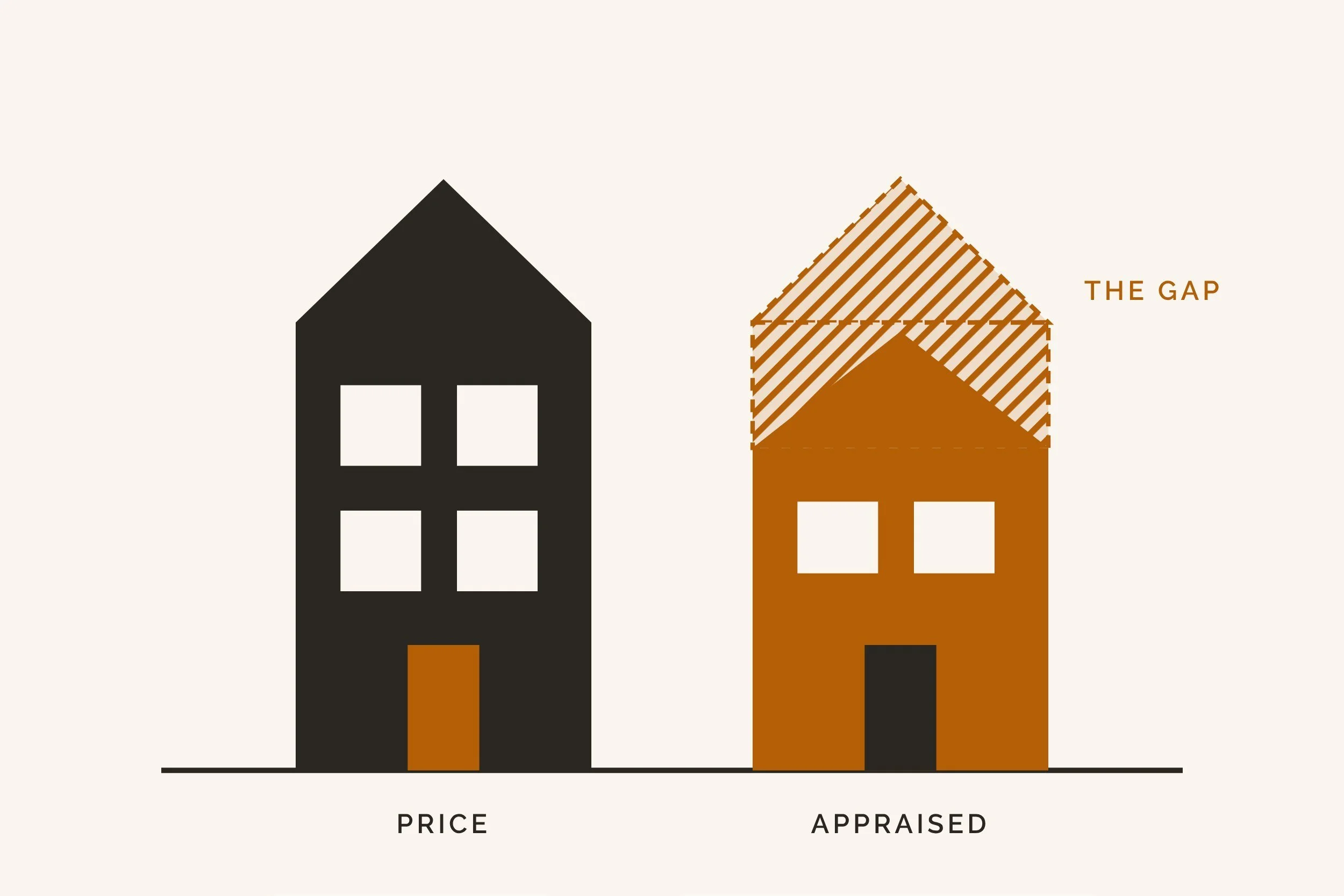
When a lender’s appraisal comes in under the price, the difference is the appraisal gap. The lender lends on the lower number, so someone has to close the gap: the buyer brings more cash, the seller lowers the price, the two split it, or the deal ends under the contract’s appraisal terms. In the Seattle area it’s rare, about 1 in 20 house appraisals in a normal year, and twice that in the winter quarter, when contracts run ahead of the last sales.
Low appraisal calculator
Your gap, your cash, your next step
Tap your side, loan and contract terms, then enter the price and the appraised value. Everything updates as you type; nothing leaves this page.
The gap
Three ways to close
Your to-do list
General information about how standard NWMLS forms and loan rules work, not legal or lending advice. Closing costs aren’t included. Your lender decides your loan; your agreement controls.
Low appraisals are rare on my own deals, and the few I’ve handled were stressful for both sides. Use the calculator for your numbers; below is how each piece works. This is how the forms and loan rules work, not legal or lending advice: your lender has the final word on your loan, and your agreement controls.
Same thing, other names: a low appraisal, an appraisal shortfall, a home that “didn’t appraise” or appraised under contract. A buyer’s promise to cover it is called appraisal gap coverage, an appraisal gap guarantee or clause, and in Washington’s NWMLS paperwork, Form 22AD, the Increased Down Payment for Low Appraisal Addendum.
The gap
An appraisal gap is the price minus the appraised value
A buyer’s lender orders an appraisal to confirm the home is worth what the loan assumes. Fannie Mae, whose rules most conventional loans follow, figures the loan-to-value ratio on the lower of the sales price or the appraised value. FHA does the same, and a VA loan needs no down payment only as long as the price isn’t higher than the appraised value.
So when a $1,350,000 home appraises at $1,300,000, the lender treats it as a $1,300,000 home. The $50,000 difference is the gap, and the loan won’t cover it.
An appraisal above the price doesn’t help the loan either: the lower number still wins. It’s good news for your equity, nothing more.
Your cash
What a low appraisal does to your cash at closing
This is the part buyers ask me about most: does the extra money count toward my down payment? Your lender’s answer will be some version of no. The down payment is measured against the lower value, so the gap comes on top of it.
Here’s the $1,350,000 example with 20% down. Before the appraisal, the plan was $270,000 down and a $1,080,000 loan. After a $1,300,000 appraisal, there are three common ways to close:
- 01Same down payment percent, full price: $310,000. The loan drops to 80% of $1,300,000, or $1,040,000. Cash needed rises $40,000, not the full $50,000, because your 20% now applies to the lower value.
- 02Same loan, full price: $270,000. Cash stays at $270,000, but the loan is now 83% of the value. A conforming loan over 80% needs mortgage insurance under Fannie Mae’s rules, and a jumbo lender sets its own limits, so this one is your lender’s call.
- 03The seller lowers the price to $1,300,000: $260,000. 20% down on the lower price, with the same $1,040,000 loan.
One King County wrinkle: the 2026 conforming loan limit is $1,063,750. In this example the original $1,080,000 loan is a jumbo loan and the $1,040,000 loan isn’t, so a low appraisal can change your loan program, rate and rules. Ask your lender to run all three versions before you decide anything. Closing costs come on top of every number here.
By the numbers
How often homes appraise low in Seattle
Less often than people fear. FHFA publishes statistics on the appraisals behind Fannie Mae and Freddie Mac loans, by metro area. In the Seattle-Bellevue-Kent area (King and Snohomish counties), 4.7% of purchase appraisals on houses came in below the contract price in 2023, against 8.6% nationally. Even in 2021, the peak of the bidding wars, it was 11.4%.
The season matters more than the year. From 2013 to 2023, 8.6% of Seattle-area house appraisals done in January to March came in low, twice the 4.2% from July to September. Contracts written as the spring market heats up meet comparable sales from the slow months before. Condos follow the same pattern.
Nationally, NAR’s September 2026 survey found 5% of contracts were delayed by appraisal issues, and 18% of buyers waived the appraisal contingency.
The cause
Why appraisals come in low
An appraiser values a home from closed sales, adjusted for differences. In FHFA’s data those sales were typically about six months old, so in a rising market the evidence trails the contract. Appraisers can adjust for that, and mostly don’t: FHFA found about 64% of comparable sales warranted a market-change adjustment, against about 13% that got one.
Closed 4 months agoSale B
Closed 3 months agoSale C
Closed 6 weeks agoYour contract
Signed this week
In Seattle, the low ones I see share a few traits:
- Bidding wars.When several buyers push a price past the last sale, the appraisal has to catch up. Bidding wars explains how an escalated price meets the appraisal.
- Thin or stale comps.Winter and early spring, unusual homes, view homes, and homes with an ADU or a condoized lot (ADU condos).
- Condition and details.Unupdated interiors, a miscounted room or square footage, a misread neighborhood boundary.
- Lender-required repairs.An appraisal can also come back “subject to” repairs instead of low; lender-required repairs covers those.
Your contract
What happens next depends on one line in your contract
In Washington, the appraisal terms live in the NWMLS financing addendum (Form 22A) or a buyer’s added addendum. There are three common setups, and the calculator above shows which path yours takes:
Standard: Form 22A, paragraph 5
BuyerNotice of low appraisal
SellerReappraise, lower, split or reject
BuyerClose or end it, refund
Promised extra: Form 22AD
BuyerPays up to a set amount
Still short?Notice to seller
SellerLower the price or end it
Waived appraisal terms
BuyerOwes the full price
GapBuyer’s cash
Can’t close?Possible default
Standard. Form 22A paragraph 5 gives the buyer a notice, the seller a response (pay for a reappraisal or reconsideration, lower the price, propose a price in between with the buyer adding cash, or reject) and the buyer a final choice. The deadlines and the waiver checkboxes are in the financing contingency post.
Promised extra (Form 22AD). The buyer agrees ahead of time to pay up to a set dollar amount toward the down payment if the appraisal is low, and that replaces paragraph 5. The test is simple: if the appraised value plus the promised amount reaches the price, the buyer closes at the price. If it still falls short, the buyer may tell the seller, with the appraisal, within 3 days (unless another number is filled in). The seller then has 3 days to lower the price to the appraised value plus the promised amount, or end the agreement with the earnest money refunded. No answer ends it, with a refund.
a. If the lender’s appraised value is less than the price, the buyer pays additional funds up to $25,000 toward the down payment.
In the example, a $25,000 promise and a $1,300,000 appraisal add up to $1,325,000, still $25,000 short. The buyer can give notice; the seller can drop the price to $1,325,000 or end it. With a $50,000 promise, the buyer closes at $1,350,000.
Waived. A buyer who waived the appraisal protection, or who has no financing contingency at all, owes the full price whatever the appraisal says. Not closing then can be a default; what happens if a buyer backs out covers that. FHA and VA buyers keep a federal escape clause either way: the VA wording says the buyer isn’t obligated if the price exceeds the VA’s value, and Form 22A has both sides sign the required amendatory clause.
How much to promise, whether to waive and how a promise pairs with an escalation are offer strategy I cover with clients in the buyer guide and seller guide.
Reconsideration of value
How to challenge a low appraisal
Start with the report itself. Federal rules require your lender to give you a copy of the appraisal promptly, and no later than three business days before closing unless you waive that timing. Read it for facts: bedrooms, square footage, lot, condition, the comparable sales chosen.
If something is wrong or a better sale was missed, the formal path is a reconsideration of value, made through your lender. Fannie Mae requires lenders to accept one borrower request per appraisal, with what’s wrong and up to five more comparable sales, and none after closing. VA appraisals add an early step, the Tidewater procedure: when the value looks short, the appraiser gives the parties two business days to send more sales before finishing. And since July 11, 2026, the ROAD to Housing Act has directed FHA, VA, USDA and FHFA to keep a process for these requests.
- 01Read the reportFacts first: rooms, square feet, comps
- 02Gather salesClosed, similar, nearby, recent
- 03Request through your lenderOne borrower request per appraisal
- 04Appraiser respondsValue changes, or doesn’t
- 05Back to the contractParagraph 5 or 22AD takes over
It can work. In October 2026, on one of my listings, an FHA buyer’s appraisal came in about 6% under the price. The buyer’s lender sent a reconsideration with better sales, and three days later the value came up $10,000. My seller chose to lower the price to the new value, and we extended closing by addendum. As I wrote during that one, “The person who has the most stress is always the seller!”
It doesn’t always work. In 2018 one of my buyers’ appraisals came in about 13% under on an unupdated house, and the lender refused a second appraisal as shopping for a value. A seller can offer to pay for a reappraisal under paragraph 5, but the form itself warns that the lender may not accept it.
Value acceptance
When there’s no appraisal at all
Some conventional loans skip the appraisal. Fannie Mae calls it value acceptance (it used to be an appraisal waiver): its system accepts the value when it already has good data, up to 90% loan-to-value on a home you’ll live in.
At Seattle prices most buyers won’t see one. Fannie Mae’s rule excludes any purchase where the price or estimated value is $1,000,000 or more, along with 2- to 4-unit homes and proposed construction. Below that line it’s your lender’s call, not yours.
Sellers
If you’re the seller
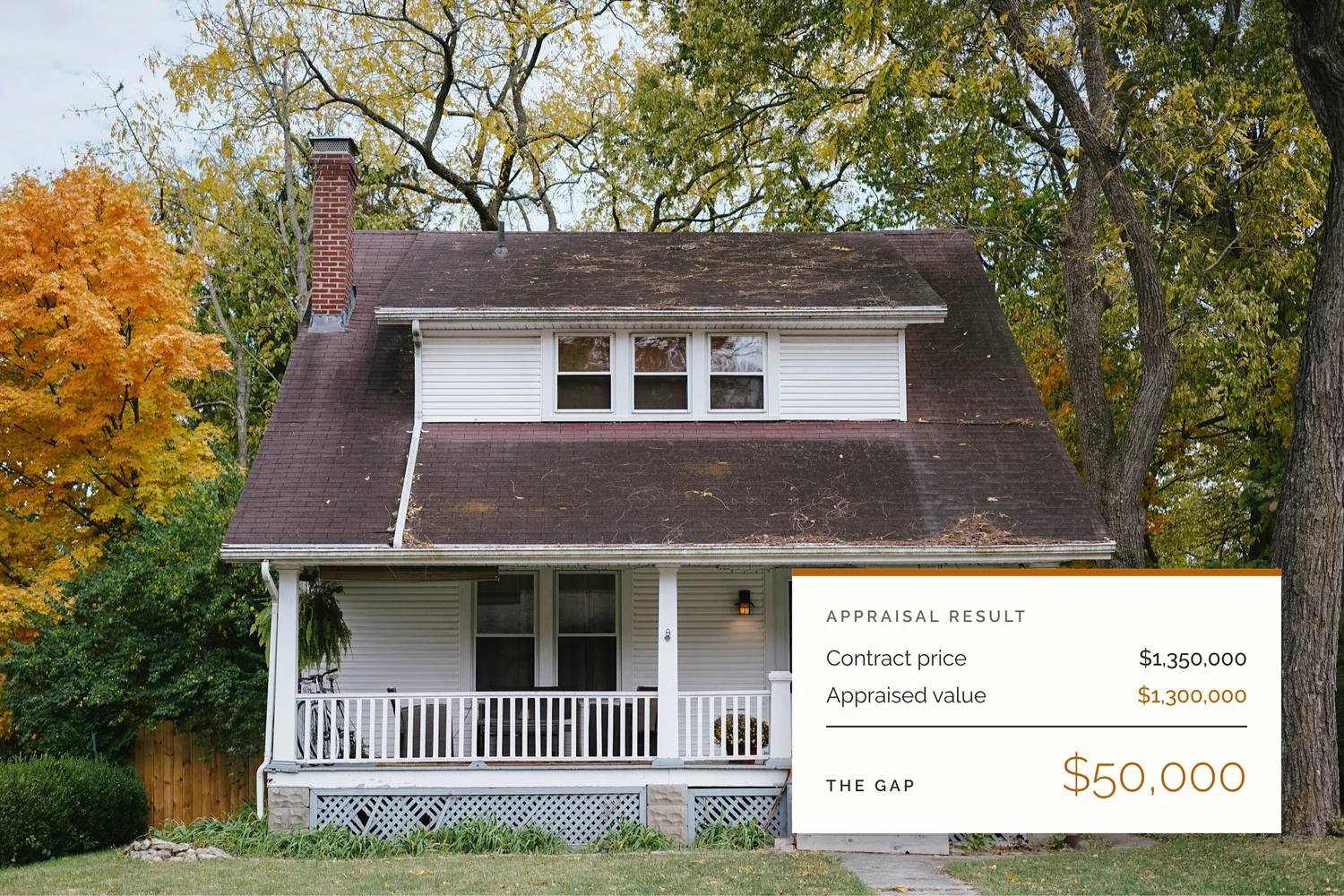
A low appraisal on your buyer’s loan isn’t a ruling on your home, but it does reset the conversation. Under paragraph 5 you choose a response; under 22AD your buyer may already have the gap covered; with a waiver the buyer owes the full price. Here’s what the example looks like from your side:
A deal that falls apart puts the home back on the market, which costs time too, so most of these end in a compromise. Whether to pay for a reappraisal, how far to move and what to counter are seller strategy I cover with clients in the seller guide and in how I review offers.
FAQ
Frequently asked questions about low appraisals
What is an appraisal gap?
The difference between the purchase price and a lower appraised value. On a $1,350,000 contract that appraises at $1,300,000, the gap is $50,000. The lender lends on the lower number, so the gap has to come from the buyer’s cash, a lower price, or both.
What does a $10,000 appraisal gap mean in an offer?
That the buyer promises to pay up to $10,000 of a low appraisal in cash, on top of the down payment. In Washington it’s written on NWMLS Form 22AD. If the appraisal comes in more than $10,000 short, the buyer can give notice and the seller can lower the price or end the deal.
What happens if a house appraises for less than the offer?
It depends on the contract. Under Form 22A paragraph 5 the buyer can give notice and the seller chooses how to respond. Under Form 22AD the buyer covers up to the promised amount. If the buyer waived the appraisal protection, the buyer owes the full price.
Who pays the appraisal gap?
Whoever agrees to. Usually it’s the buyer’s cash, the seller’s price cut, or a split. Nobody is required to pay it unless the contract says so.
Does paying the gap count toward my down payment?
No. The lender measures your down payment against the lower of the price or the appraised value, so gap money is extra. A low appraisal can also push your loan over 80% of the value, which means mortgage insurance on a conventional loan.
How often do appraisals come in low in Seattle?
About 1 in 20 house appraisals in a normal year: 4.7% in the Seattle-Bellevue-Kent area in 2023, per FHFA, with a high of 11.4% in 2021. January to March runs about twice the July to September rate.
Can a seller walk away if the appraisal is low?
Not on their own. Under Form 22A paragraph 5 the seller can reject the buyer’s low-appraisal notice, and then the buyer decides to close or end it. Under Form 22AD, if the promise doesn’t cover the gap and the buyer gives notice, the seller can choose to end it with the earnest money refunded.
What is the 3-day appraisal rule?
Two different things go by that name. Federal rules require your lender to give you the appraisal at least three business days before closing unless you waive it. And in Washington’s Form 22A, the buyer has 3 days after receiving a low appraisal to give the seller notice.
Can I challenge a low appraisal?
Yes, through your lender, with a reconsideration of value: what’s wrong in the report and better comparable sales. Fannie Mae allows one borrower request per appraisal, and none after closing. A higher value isn’t guaranteed.
Can the seller order a second appraisal?
Under Form 22A paragraph 5, the seller can pay for a reappraisal or reconsideration by the same appraiser or another one acceptable to the lender. The lender doesn’t have to accept it.
Is offering appraisal gap coverage worth it?
It depends on your cash, the home and the competition, which makes it strategy rather than a rule. I go through it with buyers in my buyer guide.
Do cash buyers need an appraisal?
No lender requires one, but a cash buyer can still make the sale contingent on an appraisal with the NWMLS Appraisal Addendum (Form 22AA). With no lender, the buyer orders the appraisal.
The bottom line
A low appraisal is rare in Seattle, about 1 in 20 house appraisals, and more likely in winter and early spring. When it happens, the lender lends on the lower value, the gap comes on top of your down payment, and your contract decides the next move: paragraph 5, a 22AD promise, or a waiver.
Ask your lender to run your numbers before you offer, read the appraisal when it arrives, and use the reconsideration process when the facts are wrong. If you’re buying, start with how I help buyers and the lenders I trust; if you’re selling, how I sell homes.
Sources
- NWMLS 2026 forms revision samples: Form 22A Financing Addendum (Rev. 2/26), paragraphs 5 to 7, Northwest Multiple Listing Service (sample packet)
- Form 22AD, Increased Down Payment for Low Appraisal Addendum (Rev. 4/21), Northwest Multiple Listing Service
- B2-1.2-01, Loan-to-Value (LTV) Ratios, Fannie Mae Selling Guide
- B7-1-01, Provision of Mortgage Insurance (04/02/2025), Fannie Mae Selling Guide
- B4-1.4-10, Value Acceptance (06/03/2026), Fannie Mae Selling Guide
- Fannie Mae announces changes to appraisal alternatives requirements (October 28, 2024), Fannie Mae
- B4-1.3-12, Appraisal Quality Matters: borrower-initiated reconsideration of value (09/03/2025), Fannie Mae Selling Guide
- FHA maximum mortgage and 3.5% minimum investment, applied to the lesser of value or price, U.S. Department of Housing and Urban Development
- VA-backed purchase loans: no down payment if the price isn’t above the appraised value, U.S. Department of Veterans Affairs
- VA appraisal policies: the Tidewater procedure, U.S. Department of Veterans Affairs
- 12 CFR 1002.14, Rules on providing appraisals and other valuations, Consumer Financial Protection Bureau
- UAD Aggregate Statistics data file, 2013 to 2024 Q3 (Seattle-Bellevue-Kent and U.S., purchase appraisals), Federal Housing Finance Agency
- FHFA cites underutilization of appraisal time adjustments (January 8, 2024), a summary of FHFA’s analysis, Consumer Finance Monitor, Ballard Spahr
- 2026 conforming loan limits by county (King County, one unit: $1,063,750), Federal Housing Finance Agency
- REALTORS Confidence Index, September 2026 (released October 13, 2026), National Association of REALTORS
- The 21st Century ROAD to Housing Act (P.L. 119-101), September 17, 2026, Congressional Research Service
- How to dispute a low appraisal under the ROAD to Housing Act, Section 704, Lower