
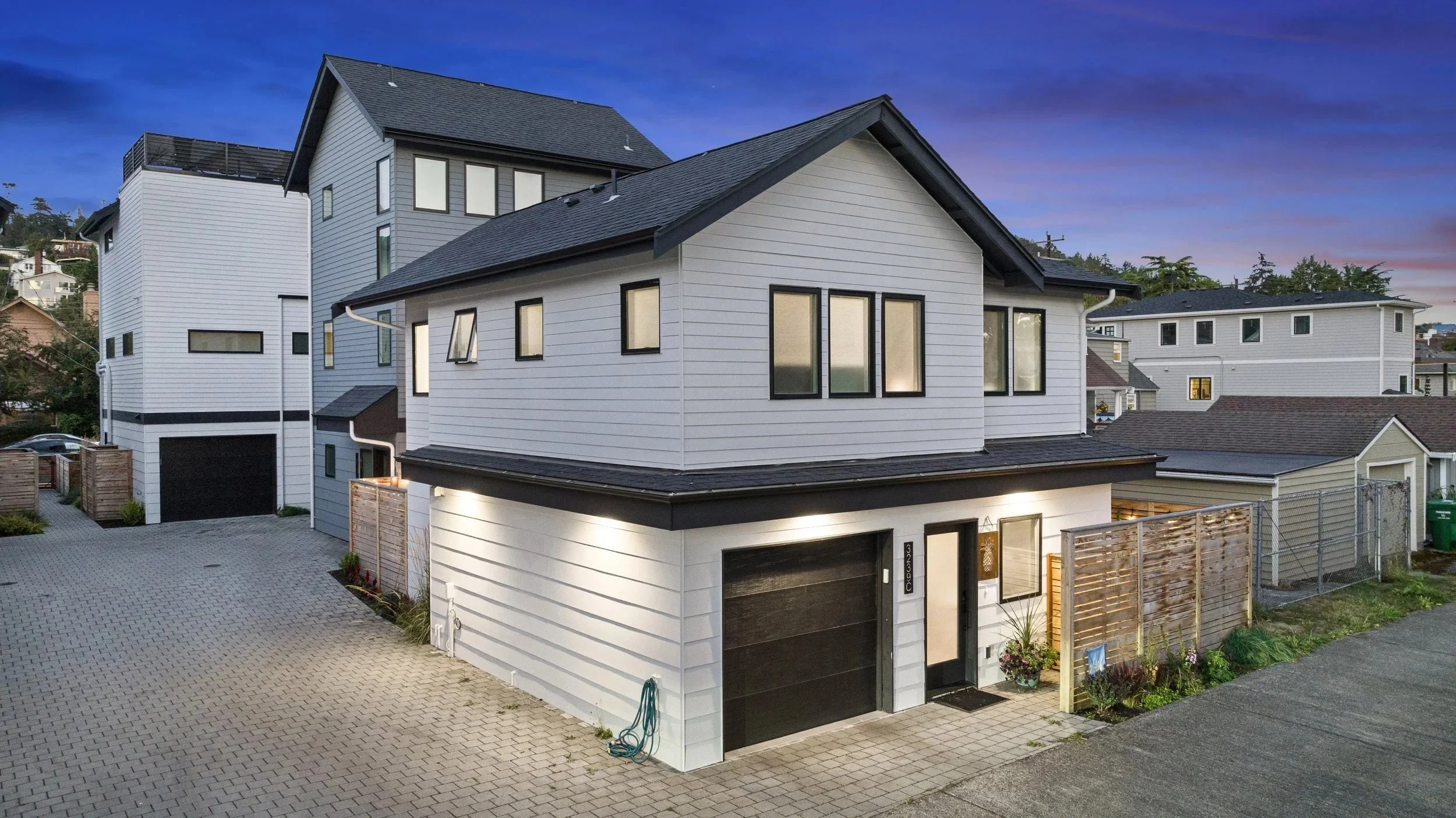
Short answer: it's a condo with a yard.
Real answer: ADU condoization turns one Seattle lot into a small condominium. The main house, an attached unit and a backyard cottage can each have their own deed, loan and owner. That's why a detached home can be listed as a condo with HOA dues. You own your home outright, but the land under it is shared. A two- or three-owner association runs it. Pick your setup below to see what you'd own, what you'd share, what it costs each month and how lenders look at it.
ADU condo checker
What you’d own, share and pay
Buyers ask me some version of the same question every month: why does this little house have HOA dues? The short answer is that it's a condo with a yard. ADU condos have been around in Seattle for decades, started to make a mark around 2015 and took off between 2019 and 2022. They can be a good way into a neighborhood that would otherwise be out of reach. Just read the paperwork that comes with them.
The basics
What ADU condoization means
Two recorded documents
A condominium in Washington is created by recording 2 documents with the county: a declaration and a map of the units. A licensed land surveyor certifies the map. Once they're recorded, each home on the lot becomes a unit that can be deeded, financed and sold on its own.
Yours, shared, and yours in practice
Everything that isn't a unit is a common element, owned together. Some common ground is set aside for one owner, like a fenced yard, a patio or a parking pad. That's a limited common element: shared on paper, yours in practice.
- Unit 1: the main house. Often the original home, sometimes rebuilt.
- Unit 2: an attached ADU. A basement or lower-level unit, or an addition to the side or back of the house.
- Unit 3: a backyard cottage (DADU). A detached ADU, often over a garage or along the alley.
- Each unit gets its own deed and loan. After the county creates the new tax parcels, each gets its own property tax bill too.
- The lot itself isn't split. Seattle doesn't let an ADU be subdivided from the main house. A condo doesn't divide the land; it divides ownership of the homes on it.
Detached, but a condo
Why a detached Seattle home can be listed as a condo with HOA dues
It's a legal label, not a building type. A detached cottage with its own front door and fenced yard is still a unit in a condominium. The listing, the loan and the purchase forms all treat it as a condo. The HOA is usually just the 2 or 3 owners, and the dues are small because there's very little to run.
- What the dues typically cover: water submetering, liability insurance for the shared ground and the state filing that keeps the association active. On a recent new-construction three-unit sale, the dues also covered garbage.
- What they usually don't: your own water and sewer use, property tax, insurance on a detached home, and your own repairs.
- Who runs it: the owners. Associations this small are usually self-managed, with an attorney on call rather than a property manager.
The rules
Why you're seeing more ADU condos in Seattle and Washington
- Seattle, 2019. Ordinance 125854 allowed 2 ADUs on most single-family lots, dropped the owner-occupancy rule and removed parking requirements for ADUs.
- Washington, 2023. House Bill 1337 made those rules statewide in urban growth areas: at least 2 ADUs per lot, no owner-occupancy requirement, and no city may block the sale of a condo unit just because it was built as an ADU.
- Builders followed. A new house, an attached unit and a cottage on one lot, sold as 3 condos, lets a builder offer 3 smaller price points in a neighborhood of larger homes.
- Seattle today. Some lots are now zoned for 4 or more homes, but SDCI still allows only 2 of them to be ADUs. More homes than that use other ownership setups.
3 ways to own
ADU condo vs. unit lot subdivision vs. a single-family house
Washington now requires its growing cities to offer a second way to sell homes on one lot separately. It's called a unit lot subdivision. Each home sits on its own small lot, and the leftover ground is owned in common. Here's how the 3 compare for a buyer.
| ADU condo | Unit lot subdivision | Single-family house | |
|---|---|---|---|
| What you own | Your unit, plus a share of the land as a common element | Your home and the small unit lot under it | The house and the whole lot |
| How it's created | Declaration and survey map recorded with the county | A city subdivision approval and recorded plat | Already exists |
| Association | Required; owners share common costs | Often an HOA for the shared drive and walkways | None, unless the neighborhood has one |
| Conventional loan | Condo loan; Fannie Mae waives the project review for 2 to 4 units | Typically treated like a house | House loan |
| FHA or VA loan | Needs condo approval for that project | Typically treated like a house | House loan |
| At resale | Resale certificate from the association | HOA documents, if there is an HOA | Seller disclosure (Form 17) |
| Online listing | Shows as a condo, which can narrow the buyer pool | Shows as a townhouse or house | Shows as a house |
Costs
What an ADU condo costs each month, beyond the mortgage
These are the costs that make separate ownership work on one lot. They're usually modest and predictable, and far lower than buyers expect when they hear the word HOA.
- Water submetering, about $30 per unit per month. Most ADU condos are served by one Seattle Public Utilities meter for the whole lot. Submeters and a billing service split that bill by actual use. Until the submeters are live, which can take weeks to months after closing, the declaration usually splits the bill by percentage.
- Liability insurance, about $10 to $20 per unit per month. Washington condo law requires the association to carry liability coverage for the common elements, like a shared driveway, walkway or drainage. Your homeowners policy doesn't cover shared ground.
- Building insurance, if units share a building. When a unit is in the same building as another, the association's property policy has to include the units themselves. Detached units are handled however the declaration says, so read it before you shop for insurance.
- State filing, $20 a year for the whole association. Most small HOAs are Washington nonprofit corporations. The annual report keeps them active, and the fee is $20 when the association's gross revenue is under $500,000.
- Sewer capacity charge, new construction in King County. Every new sewer connection pays King County monthly for 15 years. At the 2026 rate that's $46.01 a month for an ADU and $63.17 to $90.47 for a house, depending on size. It stays with the unit, so check whether it's paid off.
- Property tax, split until the parcels exist. Until the King County Assessor creates a separate parcel for each unit, there's one tax bill for the lot. On one recent sale, the purchase contract split it by percentage between the 3 units.
Financing
Getting a loan on an ADU condo
- Conventional loans: the easiest path. Fannie Mae waives the condo project review for units in a two- to four-unit condo project, new or established, and for detached condo units. Basic rules still apply: the right insurance, no condo-hotel use, and a project that isn't being dissolved.
- Rentals in the other units. In 2024 I asked a lender's condo team what happens when 2 of 3 units are rented. Their answer: a conventional loan still works, because the two- to four-unit waiver skips the review that would look at rental ratios.
- FHA loans: a cap of 2. FHA insures condo loans only in an FHA-approved project or through Single-Unit Approval. Through Single-Unit Approval, a project with fewer than 10 units can have no more than 2 FHA-insured units.
- VA loans: approval takes paperwork and time. The lender needs the recorded declaration, bylaws, articles, the recorded map and site plan, rules, a balance sheet, the budget, insurance and a completed condo questionnaire. One Seattle lender quoted 2 to 3 weeks for the last VA condo approval it handled, so start before the financing deadline gets close.
- Every lender checks insurance. Ask for the association's insurance certificate the day your offer is accepted. More on how lenders review a file: mortgage underwriting.
Before you buy
What to read before you make an offer on an ADU condo
Timeframe 5 business days to cancel after you first receive the resale certificate
Washington requires the seller to give a buyer a resale certificate from the association, signed by one of its officers or its agent. The buyer can cancel within 5 business days of first receiving it. Buying new from a builder, you get a public offering statement instead. More: condo resale certificates.
- Declaration
- What's your unit, what's shared, who maintains and insures what, and how costs are split.
- Survey map and plans
- Your unit's boundaries and every limited common element: yard, patio, parking, walkway.
- Bylaws and rules
- Rental rules are rarely just yes or no. Some need board approval, some charge a fee per tenant, some require a year of owner occupancy first.
- Budget and balance sheet
- What the dues pay for, whether there's any reserve money, and whether anyone is behind.
- Insurance certificates
- Liability coverage, and the property policy if units share a building.
- Reserve study status
- Small associations can be exempt when reserves are nominal or the study would cost more than 10% of the budget. The certificate has to say if there's no current study.
- Utilities
- Is the submeter live? Who holds the master water account? Is a sewer capacity charge still being billed?
- Permits and warranty
- A new unit can't close until its final inspection passes. New construction comes with builder warranty terms: new construction warranties.
Owners
If you own one: running a two- or three-owner association
- You are the board. Small associations work best when the owners meet once a year, keep minutes and split the jobs: insurance renewal, the state annual report, the submeter account.
- Answer the paperwork quickly. When a neighbor sells, the association owes the resale certificate within 10 days of the request, for no more than $275. On one sale, a new board president, now a neighbor instead of the builder, didn't want to fill out the buyer's lender questionnaire, and the seller nearly defaulted.
- Keep the corporation active. Letting the nonprofit filing lapse doesn't undo the condo, but a lapsed association makes lenders and buyers nervous at resale.
- Insurance never takes a year off. A lapse in liability or building coverage can stop every owner's sale or refinance.
- Rentals. Many builder declarations have no rental limits. If you want limits, the declaration is where they go, and changing it takes the owners' vote the declaration requires.
Condoizing
Condoizing your own lot: how it works
Some owners condoize a house and ADU they already own so one home can be sold later. The legal path is the same as a builder's:
- Confirm the ADUs are permitted. Each unit needs a final inspection. Unpermitted space has to be legalized first: unpermitted work.
- Have an attorney draft the declaration. It defines the units, the shared and limited common elements, cost splits, insurance, maintenance and rental rules.
- Have a licensed land surveyor prepare the map. It shows the unit boundaries and limited common elements, and it's recorded with the declaration. Know your lines first: property lines.
- Record both with the county. That's the moment the condominium exists. The Assessor then creates a parcel for each unit.
- Form and insure the association. File the nonprofit corporation, get the required insurance and set up the submeters and billing.
- Mind any tenants. If the building has more than 2 attached homes and tenants live there, state condo conversion rules give them 120 days' notice and a first chance to buy their unit.
Ask your attorney and the city whether a unit lot subdivision fits your lot better than a condo. Washington now requires cities in counties that plan under the Growth Management Act to offer a unit lot process.
FAQ
Frequently asked questions about ADU condos
What is ADU condoization?
It's turning a lot with a house and 1 or 2 ADUs into a small condominium. You record a declaration and a survey map, and each home becomes a unit with its own deed, loan and owner.
Can you sell an ADU separately in Washington State?
Yes, as a condo unit. Since 2023, state law bars cities and counties from banning the separate sale of a condo unit built as an ADU. You can't split the lot itself to sell an ADU on its own parcel.
Can you sell a DADU in Seattle?
Yes, once the lot has been condoized and the DADU is its own unit. Without that, the DADU can only be sold together with the main house.
What's the difference between a detached condo and a house?
With a house you own the land. With a detached condo you own your home, share ownership of the land with the other owners, and belong to an association. Day to day, they can live almost the same.
Why does a detached home have HOA dues?
Because it's a condo unit. The dues pay for the few shared costs, usually water submetering, liability insurance and the state filing, and sometimes garbage.
Are ADU condos a good investment?
They're often the lowest price point for a newer home in an established Seattle neighborhood. The trade-offs are an association and a smaller pool of FHA and VA buyers. The listing also shows up as a condo, which can make resale a little harder. Judge each one on its documents and price, not the label.
Can I use an FHA or VA loan on an ADU condo?
Sometimes. FHA needs project approval or Single-Unit Approval, and through Single-Unit Approval a project under 10 units can have no more than 2 FHA loans. VA needs its own condo approval. Ask your lender before you write the offer.
Does Fannie Mae review a two- or three-unit condo?
No full project review is required for units in a two- to four-unit condo project or for detached condo units. Insurance and a few basic requirements still apply.
Can I rent out my ADU condo?
Washington removed owner-occupancy rules for ADUs, so the city won't stop you, but the declaration and rules can. Read the rental section before you buy.
Who fixes the roof on a detached ADU condo?
Whoever the declaration says. Many make each owner responsible for their own building; others share some exterior costs. It's one of the first things to read.
Do I need a resale certificate for a three-unit condo?
Yes. Washington requires one for condo resales, even small ones, unless a narrow exception applies. Your lender may not ask for it on a two- to four-unit project, but you still get it. More: resale certificates.
How much does it cost to condoize an ADU?
It depends on the attorney, surveyor and lot. Plan for legal drafting, a survey map, recording fees, insurance and submeters, and get quotes before you commit. Nothing about it is a do-it-yourself filing.
Is a unit lot subdivision better than a condo?
Neither is better everywhere. A unit lot gives each owner land and usually a house-style loan; a condo is often simpler where unit lots aren't practical. It depends on the lot, the city and the plan.
The bottom line
An ADU condo is a house you own on land you share. It can be the most affordable way into a Seattle neighborhood you love, and it's a normal, legal structure, not a loophole. Read the declaration, the map and the resale certificate, check your loan type early, and know who insures and maintains what. Then it's simply a home.
Sources
- RCW 36.70A.681, Accessory dwelling units (HB 1337, 2023), Washington State Legislature
- RCW 64.90.010, Definitions (Washington Uniform Common Interest Ownership Act), Washington State Legislature
- RCW 64.90.200, Creation of common interest communities, Washington State Legislature
- RCW 64.90.245, Maps, Washington State Legislature
- RCW 64.90.470, Insurance, Washington State Legislature
- RCW 64.90.545, Reserve studies, Washington State Legislature
- RCW 64.90.600, Applicability of resale and disclosure rules, Washington State Legislature
- RCW 64.90.640, Resale certificate, Washington State Legislature
- RCW 64.90.655, Conversion buildings, Washington State Legislature
- RCW 58.17.060, Short plats and unit lot subdivisions, Washington State Legislature
- Accessory dwelling units, Seattle Department of Construction and Inspections
- Ordinance 125854, accessory dwelling units (2019): summary and fiscal note, Seattle City Clerk
- B4-2.1-02, Waiver of Project Review (08/05/2026), Fannie Mae Selling Guide
- B4-2.1-01, General Information on Project Standards, Fannie Mae Selling Guide
- HUD issues final rule on condominium financing (2019), U.S. Department of Housing and Urban Development
- Condominium mortgage insurance, U.S. Department of Housing and Urban Development
- Capacity charge: 2026 rates, King County Wastewater Treatment Division
- Annual report, nonprofit corporations (RCW 24.03A): filing fees, Washington Secretary of State