
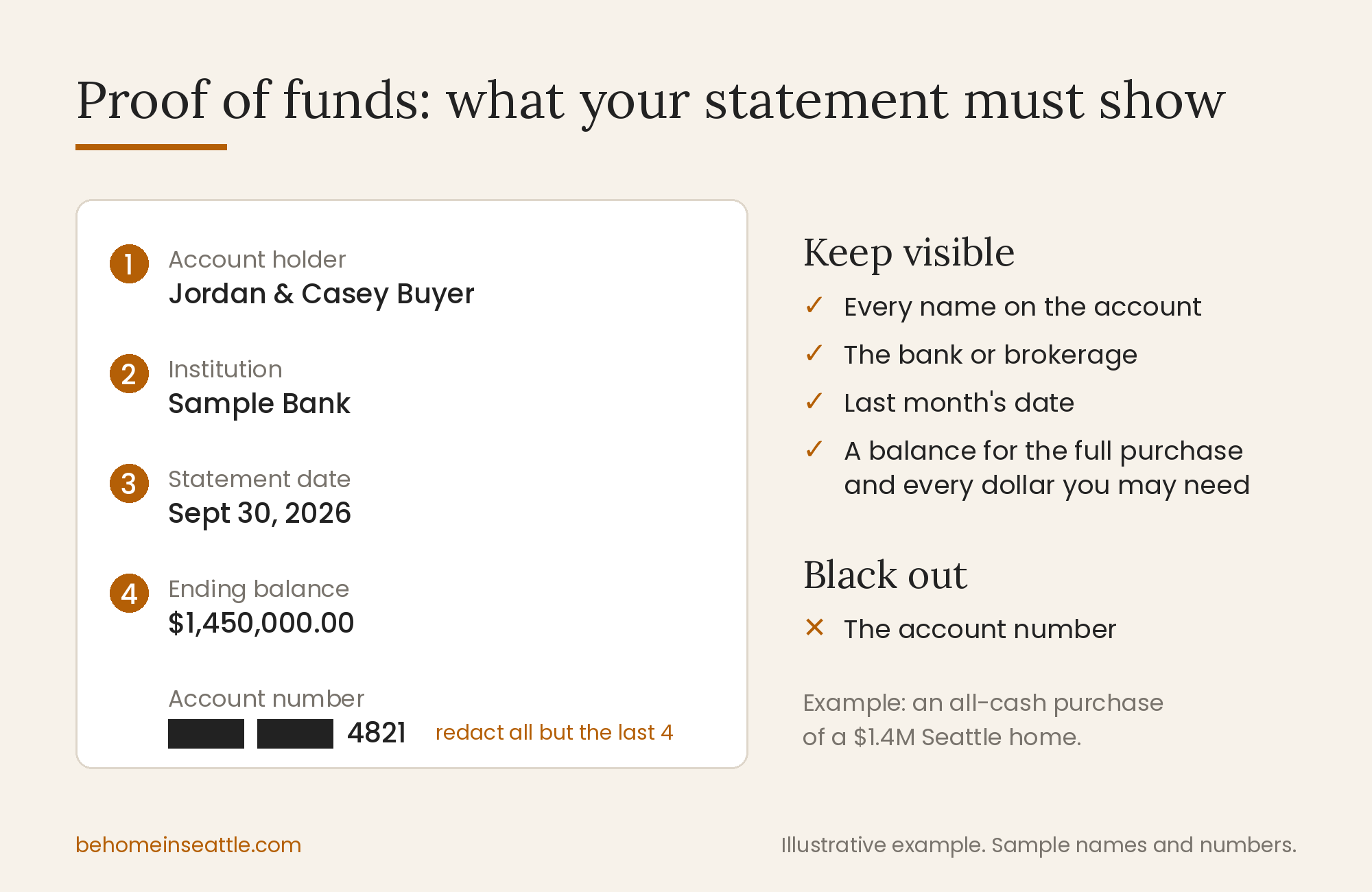
Name, bank, date, balance. Redact only the account number.
Short answer: a PDF of any and all accounts where funds will be used for the purchase of this home.
Real answer: Proof of funds is a recent statement or letter from a U.S. bank or brokerage. It shows your name, the institution, the date and a balance that covers the cash you're bringing to closing. In Seattle, listing agents commonly ask for it with cash offers and with financed offers that promise extra cash. Once you're under contract, NWMLS Form 22EF sets the deadlines. It's 3 business days for money already in your account, and 10 days before closing for money still on its way.
Proof of funds checklist
Build your proof of funds in a minute
Pick how you’re paying and where the money is. You’ll see what to send for each account, which money Form 22EF treats as ready now and which as still on its way, your default deadlines, and a checklist for the statement itself.
Add your dates (optional)
Show now: non-contingent
Disclose on Form 22EF: contingent
Your default deadlines
Check the statement before it goes out
Based on NWMLS Form 22EF (Rev. 7/23) and Form 21 (Rev. 2/26) defaults. Days start the day after the event and end at 9 p.m.; periods of 5 days or less skip weekends and Washington legal holidays (RCW 1.16.050). Your contract can set other numbers, and it controls. General information, not legal or tax advice.
Most weeks a buyer asks me what proof of funds actually is. My answer is the short one up top. The details are where buyers get stuck. Which statement? What to black out? What about stock, a gift from family or money that hasn’t landed yet? The checklist above sorts that out for your own money. The rest of this post explains why.
The basics
What counts as proof of funds for buying a house
The promise in your contract
Washington’s standard purchase agreement (NWMLS Form 21) has every buyer promise they have enough money to close. The buyer also promises they aren’t counting on a loan, a home sale, a gift, retirement money or future earnings, unless the contract says so. Proof of funds is how you back up that promise. NWMLS defines the evidence as documents from a financial institution in the United States showing enough cash or cash equivalents in U.S. dollars.
- Your full name.Every person whose money is used. A different last name, a maiden name or a parent’s name is common; your broker explains it to the listing agent.
- The bank or brokerage.A U.S. institution, by name or logo.
- The date.Last month’s statement, or a current page or screenshot from online banking. Older statements read as stale.
- The balance.Enough, across all the accounts you send, to cover the cash you’re bringing: the whole price for cash buyers, or the down payment and closing costs when there’s a loan.
Black out the account number except the last 4 digits. Leave the name, the institution, the date and the balance showing, or the page proves nothing.
| Document | What it proves | Works as proof of funds? |
|---|---|---|
| Last month’s bank statement | Cash in checking, savings or a money market account | Yes, the standard. The page with your name and balance is usually enough for a seller. |
| Brokerage statement | Cash and investments at a brokerage | Yes. Cash is ready now; stocks and funds still have to be sold, so they’re contingent until then. |
| Proof of funds letter from your bank | A balance confirmed by the institution | Yes, if it’s on letterhead with your name, the date and the available balance. |
| Online banking screenshot | Today’s balance, for example after a big deposit | Often, if it shows the bank, your name and the balance. A PDF statement is cleaner. |
| HELOC paperwork | Available credit on a home equity line | Yes, as a loan, so it’s contingent money under Form 22EF. |
| Family member’s statement and gift letter | Money someone else is giving you | Yes, as a gift, so it’s contingent until it reaches you or escrow. |
| Preapproval letter | A lender is willing to lend | No. It proves the loan, not the cash you bring on top of it. |
Bank letters
How to get a proof of funds letter from your bank
Most buyers simply send a statement. A letter helps when a statement would show more than you want to share, or when your money sits in several accounts at one institution.
- Ask your branch, private banker or brokerage advisor.Say it’s for a home purchase and you need a letter confirming your available balance.
- Check what it says.Your full name, the institution’s letterhead, the date, the available balance in U.S. dollars, and a signature or contact who can confirm it.
- Leave out what isn’t needed.The full account number and transaction history don’t belong in a letter to a seller.
- Mind the date.A letter is a snapshot. If your search runs for months, ask for a fresh one.
Timing
When Seattle sellers ask for proof of funds, and when it’s due
Before you're under contract
Before mutual acceptance, it’s whatever the listing asks for. Many Seattle listing agents ask for proof of funds with cash offers. They also ask with offers that promise cash beyond the loan (an appraisal gap or a Form 22AD). Offers that skip the financing contingency get the same ask.
After mutual acceptance
Timeframe 3 business days for money you have · 10 days before closing for money on its way
After mutual acceptance, Form 22EF sets the clock if it’s part of your contract.
- 1Before you tour. Pull last month’s statement for every account you’ll use, and keep it current while you search. Some sellers of occupied homes ask cash buyers for proof of funds before a private showing.
- 2With your offer. If the listing asks for it, it goes with the offer. Otherwise Form 22EF can set the deadline after mutual acceptance.
- 32 business days after mutual acceptance. Earnest money is due, unless your contract says otherwise. It has to be ready to wire. More on how earnest money works.
- 43 business days after mutual acceptance. Form 22EF’s default deadline to prove money that’s already in your account.
- 510 days before closing. Form 22EF’s default deadline to prove that contingent money, like a gift, a stock sale or a loan, has arrived or is immediately available.
- 6A few days before closing. You, or a family member giving you money, wire funds to escrow. Escrow holds them until the sale records.
Counting days the NWMLS way: a period starts the day after the event and ends at 9 p.m. Periods of 5 days or less skip weekends and Washington legal holidays. Counting back from closing, a deadline that lands on a weekend or holiday moves forward to the next business day. The numbers above are the form defaults; your contract can set different ones, and it controls.
Form 22EF
Form 22EF: non-contingent and contingent funds
Form 22EF, the Evidence of Funds Addendum, is a disclosure, not a contingency. It tells the seller where your money is coming from and when they’ll see proof. NWMLS says so plainly: it’s a way to give evidence of non-contingent funds and to disclose any contingent funds you’re relying on.
| Non-contingent funds | Contingent funds | |
|---|---|---|
| What it means | Money you have now, with no condition attached. | Money you don’t have yet but expect before closing: a loan, a home or stock sale, retirement funds, foreign funds, a gift, a down payment program, future earnings. |
| Proof due | 3 business days after mutual acceptance, unless filled in otherwise. | 10 days before closing, unless filled in otherwise: proof the money has arrived or is immediately available. |
| If proof is late | The seller may cancel any time before you deliver it. Your earnest money comes back. | Same: the seller may cancel before you deliver it, and your earnest money comes back. The seller can also ask reasonable questions along the way. |
| Other rules | You can’t spend that money on anything else without the seller’s written OK. | If the money still isn’t there at closing, you’re in default under your contract. |
- It doesn’t protect you.Form 22EF gives the seller a way out if proof is missing. It gives the buyer no way out if the money falls through. That’s a contingency’s job, such as a financing contingency (Form 22A).
- Funds tied to a contingency aren’t “non-contingent.”The form defines non-contingent money as money with no condition such as financing (Form 22A) or the sale of your home (Forms 22B and 22Q). Here’s how the financing contingency works.
- Telling the seller about a loan opens the door to the lender.If you disclose a loan on Form 22EF, the seller has to allow the lender’s appraisal and required inspections.
- The seller cancels with Form 90EF.That’s the NWMLS notice a seller uses to terminate when evidence doesn’t arrive on time.
How much to show, when to send it and how it fits your offer are all part of the plan I build with each client. My clients will find that in the buyer guide. For escalation clauses, see how Seattle bidding wars work; for promising cash over the appraisal, see appraisal gaps.
Where the money comes from
Stocks, retirement, HELOCs, gifts, crypto and money from abroad
- Stocks and funds.A current brokerage statement shows them, but they’re contingent until sold. Most U.S. trades now settle one business day after the sale (T+1, since May 2024); allow extra time for the cash to move to your bank.
- Retirement accounts.A 401(k) or IRA is contingent money. A withdrawal or plan loan takes paperwork and time, and has tax rules. Ask your plan administrator and your CPA before counting on it.
- HELOC.Lender paperwork showing your name, the lender and the available credit. It’s a loan, so it goes on Form 22EF as contingent, and tell your mortgage lender, since it’s new debt.
- A gift from family.Their statement plus a gift letter. It’s normal for a parent’s name to be on the statement. Lenders want the letter signed by the giver, with the amount, the giver’s contact details and relationship, and a line that no repayment is expected. A loan from family isn’t a gift; tell your lender.
- Crypto.Convert it to U.S. dollars and move it into a U.S. bank or brokerage before it counts. Fannie Mae, whose rules most conventional loans follow, accepts exchanged crypto for the down payment but not for earnest money.
- Money held outside the U.S.Form 22EF lists foreign funds as contingent, and its evidence has to come from a U.S. institution in U.S. dollars. Start the transfer early.
- Money still to arrive.A bonus, a maturing CD, a settlement, the sale of your current home. Show what you have now and list the rest as contingent. Plan for checks to clear and holidays to slow wires.
A financed buyer’s brokerage statement often mixes retirement money with cash and stock. A good lender will pull the pages that matter. If you need one, I keep a short list of local lenders on my lenders page and I’m glad to introduce you.
Lenders
Proof of funds for a seller vs. what your lender needs
Your lender and the seller ask for different things. The seller wants to know the money exists. The lender has to document where it came from.
| Seller (proof of funds) | Lender (underwriting) | |
|---|---|---|
| Statements | Last month’s statement, a bank letter, or a current screenshot. | The most recent 2 full months for a purchase, on Fannie Mae loans, complete with every transaction. |
| Transactions | Not needed. The balance page is usually enough. | All deposits and withdrawals, so they can trace the money. |
| Account number | Black out all but the last 4 digits. | At least the last 4 digits have to show. |
| Big deposits | Not asked about. | On Fannie Mae loans, any single deposit over half your monthly qualifying income needs a paper trail if you need that money. |
| Gifts | The giver’s statement and, often, a gift letter. | A signed gift letter, and proof the money is in the giver’s account or has moved to you or to escrow. |
For what buying actually costs beyond the price (down payment, closing costs, escrow, reserves), my clients use the cost estimator in the buyer guide. More on how mortgage underwriting works.
Privacy and wire fraud
Protect it: black out the account number, verify every wire
Proof of funds travels by email, through 2 brokerages and often a lender. Send only what’s needed, as its own attachment, with the account number blacked out. I’m happy to do the redaction for clients who send me the original.
Wires are where the real risk sits. The FBI received 12,368 real estate fraud complaints in 2025, with $275.1 million in reported losses, up from $173.6 million in 2024. Washington’s purchase agreement tells everyone to confirm wire instructions through an independently verified phone number before sending money.
- Call escrow at a number you already trust.Use the one on the escrow company’s website or your first paperwork, never one from the email asking you to wire.
- Treat changed instructions as fraud until proven otherwise.Real wiring instructions almost never change mid-deal.
- Family wiring money?Walk them through the same call. They’re the ones sending it.
- If money goes to the wrong account,call your bank right away to ask for a recall, then file a report at ic3.gov.
Sellers
If you’re the seller
Proof of funds tells you the money exists today. The purchase agreement adds the buyer’s promise that it’s enough. If Form 22EF is in the deal, it gives you a way to cancel when proof doesn’t arrive on time. Weighing a cash offer against a financed one is a broader question. See how Seattle sellers review offers, and my clients will find the rest in the seller guide.
FAQ
Frequently asked questions about proof of funds in Seattle
What counts as proof of funds when buying a house?
A recent statement or letter from a U.S. bank or brokerage. It shows your name, the institution, the date and a balance that covers the cash you’re bringing. Last month’s statement as a PDF is the standard.
Can I black out my account number on proof of funds?
Yes. Black out all but the last 4 digits. Keep your name, the institution, the date and the balance visible, or the page proves nothing.
How recent does a proof of funds statement need to be?
Last month’s statement. A current online banking page or screenshot showing the bank, your name and the balance also works, especially right after a large deposit.
How do I get a proof of funds letter from my bank?
Ask your branch, banker or brokerage advisor for a letter on letterhead confirming your name, the date and your available balance for a home purchase. Many buyers simply send last month’s statement instead.
Is a preapproval letter proof of funds?
No. A preapproval shows a lender is willing to lend. Proof of funds shows the cash you bring on top of the loan: the down payment and closing costs.
Do I need proof of funds if I’m getting a mortgage?
Often, yes. Sellers ask for it when an offer promises cash beyond the loan or skips the financing contingency, and your lender verifies your money separately.
When is proof of funds due in Washington?
Whenever the listing asks, often with the offer. Under NWMLS Form 22EF, the default is 3 business days after mutual acceptance for money you have now. Money still on its way is due 10 days before closing.
Is Form 22EF a contingency?
No. It’s a disclosure. If proof is late, the seller can cancel and refund your earnest money. The form gives a buyer no way out if their own money falls through.
Can my parents’ bank statement be my proof of funds?
Yes, with a gift letter saying the money is a gift. It’s contingent money on Form 22EF until it reaches you or escrow. If you’re financing, tell your lender early; lenders have their own gift rules.
Do stocks or a 401(k) count as proof of funds?
Yes, as contingent funds. Show the current statement, list them on Form 22EF, and sell or withdraw early enough for the cash to reach your bank before the deadline.
Can I use crypto or money in a foreign bank?
Not as it is. Convert crypto to U.S. dollars and move foreign money into a U.S. institution first. Until then, Form 22EF treats it as contingent.
Should a Seattle seller ask for proof of funds?
It’s common with cash offers and with financed offers that promise extra cash. Compare the balance with what the offer promises, and talk with your listing broker about the rest of the offer.
The bottom line
4 facts on one page (your name, a U.S. institution, the date and the balance) prove your money is real. Form 22EF decides when the seller sees it: 3 business days for money you have, 10 days before closing for money on its way. Have it ready before you find the house.
If you’re getting ready to buy and want a second set of eyes on your paperwork, send me a note. I’m glad to help.
Sources
- Form 22EF, Evidence of Funds Addendum (Rev. 7/23, the latest copy I could check), Northwest Multiple Listing Service, member form
- Form 21, Residential Purchase and Sale Agreement (Rev. 2/26): General Terms a, b and l, Northwest Multiple Listing Service, member form
- Legal Bulletin 216, 2019 Forms Revisions (Form 22EF), and Legal Bulletin 219, 2021 Forms Revisions (Form 90EF), Northwest Multiple Listing Service
- Selling Guide B3-4.2-01, Verification of Deposits and Assets, Fannie Mae
- Selling Guide B3-4.2-02, Depository Accounts, Fannie Mae
- Selling Guide B3-4.3-04, Personal Gifts, Fannie Mae
- Selling Guide B3-4.1-04, Virtual Currency, Fannie Mae
- SEC Finalizes Rules to Reduce Risks in Clearance and Settlement (T+1), U.S. Securities and Exchange Commission, 2023
- 2025 Internet Crime Report, FBI Internet Crime Complaint Center, April 2026
- RCW 1.16.050, Legal holidays, Washington State Legislature