
Short answer: Yours, all the way to the street.
Real answer: In Seattle, you own your side sewer from the house to the City’s main under the street, sidewalk and planting strip included. Scope it with a camera every 8 to 10 years, every 2 to 3 with big trees nearby, and always before you buy.
Side sewer checker
Is your side sewer due for a look, and who pays for it?
Pick your role, the home and what you’ve noticed. Add the distance from the house to the street for a repair range. An example is loaded. Nothing you enter leaves this page.
Your checklist
Costs and schedules: Seattle Public Utilities. Repair range uses SPU’s $100 to $170 per foot for relining or pipe bursting; digging, street work and shared lines cost more. Ownership: Seattle Municipal Code 21.16. General information, not legal advice.
The side sewer is one of the priciest surprises in an older Seattle house, and it never shows up in listing photos. The checker above sizes up yours. The rest of this post is how the pipe works, how to read it and what fixing it costs.
Same thing, other names: sewer line, sewer lateral, lateral or main sewer line. The camera check is a sewer scope, sewer camera inspection or sewer video inspection. Not on public sewer at all? Then you have a septic system, and my septic post is the one you want.
Ownership
Who owns the side sewer in Seattle?
The line you own
A side sewer is the private pipe that carries wastewater from your sinks, toilets and drains to the public sewer.
In Seattle, the owner owns it up to the City’s main. That includes the part under the sidewalk and street (Seattle Public Utilities).
The City’s job starts at the tee or wye where your pipe meets the main. If the camera shows damage right at that connection, SPU will review the video.
Condos and shared lines
In a condo, the building’s side sewer is a common element in most buildings. Your unit’s drains are yours; the line to the street usually belongs to the association.
Some houses share one side sewer with a neighbor. From the point the pipes join, both owners share repairs.
Outside Seattle
Other cities and sewer districts set their own rules. Some stop the owner’s part at the property line. Ask yours before you price a repair.
Records
Find your side sewer card
How to look it up
Seattle keeps a scanned record of almost every side sewer permit. Look yours up on the SDCI side sewer card viewer by address.
Type only the house number and street name. The card loads with a lateral map and an aerial photo.
What the card shows, and what it doesn’t
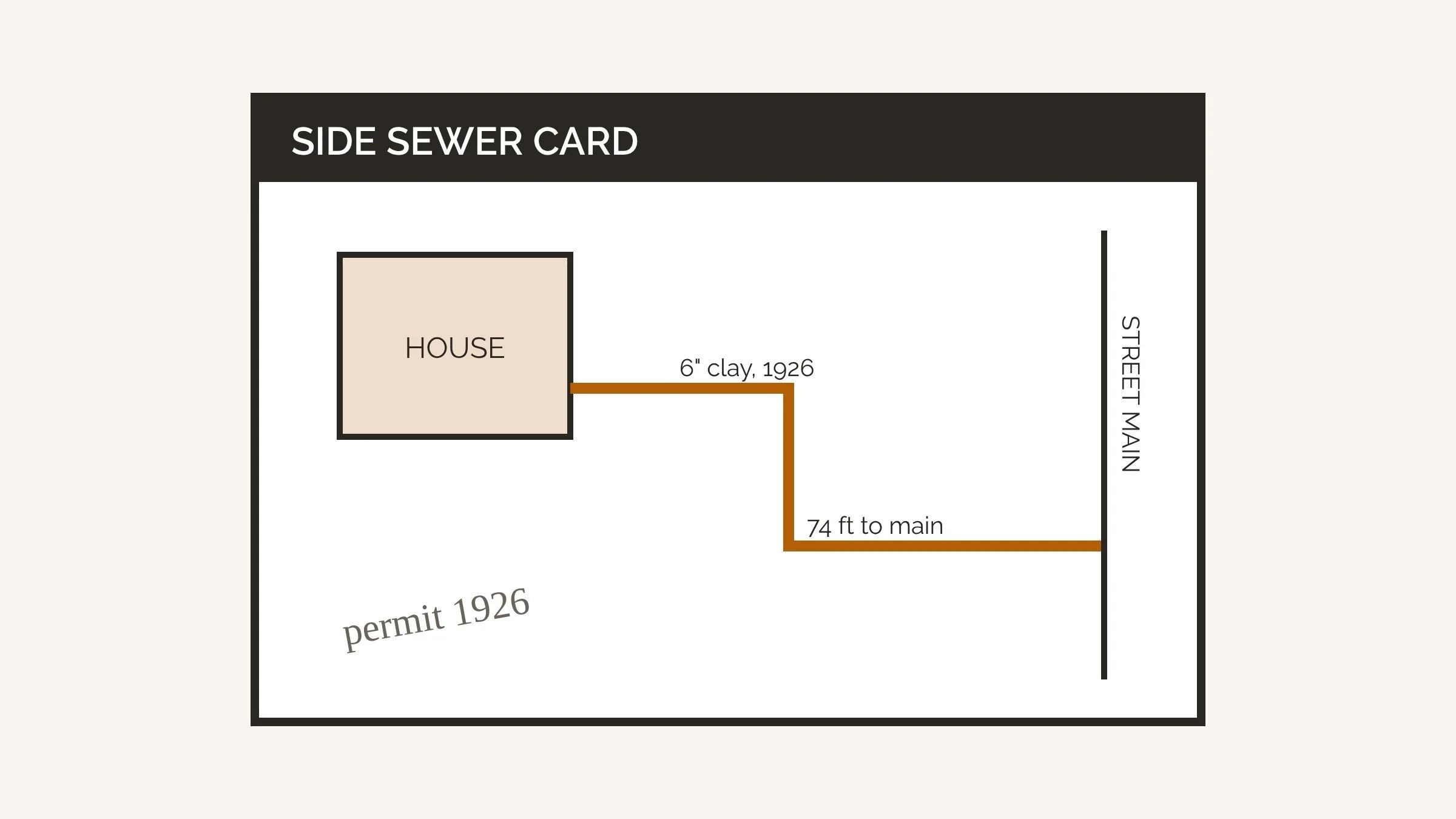
A card shows where the pipe was permitted to run, the pipe size and type, and the year. Some cards are a hundred years old.
It doesn’t show the pipe’s condition today, and later repairs may be missing. A card is a map, not a report.
I also use the card before planning a bathroom addition. It tells you where the line runs and how deep it may be.
Sewer scope
Sewer scope: when to run a camera, and what it costs
When to scope
Timeframe Every 8 to 10 years; 2 to 3 with big trees; always before you buy
Seattle Public Utilities suggests a camera scope at least every 8 to 10 years (SPU guide).
With big trees or shrubs near the line, make it every 2 to 3 years. And scope before you buy any house.
Scope now if drains run slow, gurgle or back up. Those are the pipe telling you something.
What a scope costs
SPU puts a video inspection at $230 to $845, depending on the pipe. My clients paid $295 to $325 for a scope in 2026.
Some rooter companies offer a free scope with a cleaning. A free scope from the company selling the repair deserves a second opinion.
What a scope can’t see
A scope runs from a cleanout or a pulled toilet down the main line to the street. It does not check each sink or shower drain; the camera is too big.
Ask for the video file and a written report with footage marks. A future buyer, contractor or SPU will want them.
Findings
What a sewer scope finds, and what needs fixing
How the City grades defects
SPU grades common defects by how bad they are (side sewer defects). Minor ones need nothing. Moderate ones need another look in a few years.
Severe ones need repair: offset joints with soil showing, holes, collapsed sections and sags of half the pipe or more.
Most older Seattle lines show something. The question is whether it holds water, catches debris or lets soil in.
| Defect | Leave it | Watch it | Repair it |
|---|---|---|---|
| Offset joint | Small step | Debris builds | Soil showing or a void |
| Sag (belly) | Under 25% of pipe | 25% to 50% | 50% or more |
| Crack | Hairline | Growing | Near collapse |
| Roots | A few hairs | Partly blocks flow | Blocks the pipe |
| Grease or debris | Under 25% of pipe | 25% to 50% | More than half |
Bellies, roots and clay
A belly is a low spot where water sits. Small ones are common; the largest I’ve seen on a client’s scope ran about 5 feet.
Roots find the joints of old clay and concrete pipe. Cutting them out buys time; it doesn’t seal the joint.
Pipe from before about 1950 is often clay or concrete with joints that weren’t watertight. That’s where roots and offsets start.
Repairs
Side sewer repair in Seattle: methods, permits and real bids
Clean it or fix it
Cleaning clears roots and grease. SPU says it generally costs under $1,500, and it needs no permit.
A broken, collapsed or offset pipe needs a repair. That always needs a permit, on your lot and in the street.
Four ways to repair a side sewer
The City lists four repair types (repair methods). A spot repair digs one hole to replace one bad section.
Open cut replaces a long run by digging it up. Pipe bursting pulls a new pipe through the old one. Lining cures a new pipe inside the old one.
- Dig one holeSpot repairReplaces one bad section.
- Dig the runOpen cutReplaces a long stretch.
- Two pitsPipe burstingPulls new pipe through the old.
- Two pitsLiningCures a new pipe inside the old.
Permits
In Seattle, a sanitary repair permit on private property generally costs $280 (SPU permits).
Work in the sidewalk or street also needs a Seattle Department of Transportation permit, and it adds traffic control and restoration.
A City inspector checks the work before it’s covered, then again at the end.
Three bids, one job
One North Beach owner got three bids for the same repair and reline in 2026: $14,800, $16,800 and $32,000. The line was shared with a neighbor.
He picked the middle bid for its 15-year warranty and because that crew had already fixed the neighbor’s side.
Help paying
Seattle’s Side Sewer Assistance Program offers interest-free loans to income-eligible owners who live in the home.
It covers repair of a broken or collapsed line, not cleaning or a liner alone.
King County’s side sewer repair rebate, up to $5,000 in the Lakehaven and Midway sewer districts, was at capacity in November 2026 (King County).
On one purchase, the camera couldn’t get past a clog just beyond the seller’s recent repair. The card showed the line running under the neighbor’s house to a shared wye. We extended the inspection period, the sellers dug and replaced two sections, and a new scope ran clean to the main.
Prevention
Keep the sewer from backing up
Habits
Flush only toilet paper. Wipes labeled flushable still clog.
Keep cooking oil and grease out of the sink. Let it cool, then put it in the trash.
Do
- Flush only toilet paper
- Let grease cool, then trash it
- Add a backwater valve below street level
- Scope on schedule
Skip
- “Flushable” wipes
- Grease down the sink
- Planting trees over the line
- Waiting for a backup
A backwater valve
A backwater valve lets sewage leave the house and stops it from coming back in when the main backs up.
It matters most for a home with a basement bathroom or floor drain below street level.
Buying and selling
Selling or buying a house with an older side sewer
Sellers
Form 17, Item 3, asks whether the house is on public sewer and connected to the main (RCW 64.06.020). Answer what you know, plainly.
A scope before you list lets you fix it, price it or disclose it on your schedule. My pre-listing inspection post covers timing.
Where the sewer shows up in a Washington sale
- Form 17, Item 3: public sewer? connected to the main?
- Form 35: sewer inspection box (included if left unchecked)
- Side sewer card
- Scope video and report
NWMLS Forms Rev. 2/26 and RCW 64.06.020. Illustrative.
Buyers
On NWMLS Form 35, the sewer inspection box says your inspection may include a sewer scope, and it does if left unchecked (NWMLS forms).
Book the scope early in your inspection period. A bad video leaves time for a bid before the deadline.
Related checks
New builds can still hold construction debris; see my new construction inspection post. For the rest of the inspection, see what a home inspection covers.
Older Seattle houses can also hide a buried heating oil tank. That has its own post.
FAQ
Frequently asked questions about side sewers
Who is responsible for the sewer line from the house to the street in Seattle?
The owner. Seattle Municipal Code 21.16 puts the whole side sewer on the owner, up to the tee or wye at the City’s main.
Who pays if the sewer line under the street breaks?
In Seattle, the owner pays for their side sewer even under the street. The City handles the main and the connection to it.
How much does a sewer scope cost in Seattle?
SPU puts it at $230 to $845. My clients paid $295 to $325 in 2026, often added to a home inspection.
Is a sewer scope worth it?
Yes on any older house. It costs a few hundred dollars and checks a line that can cost tens of thousands to replace.
How do I find my side sewer card?
Search “Seattle side sewer card” and use the SDCI viewer. Enter only the house number and street name.
How much does side sewer repair cost?
SPU puts no-dig repair at $100 to $170 per foot. Digging, street work and shared lines cost more; real 2026 bids ran $14,800 to $32,000.
Do I need a permit to fix my side sewer?
Yes for any repair in Seattle, on your lot or in the street. Cleaning roots or clogs needs no permit.
Does homeowners insurance cover a broken sewer line?
Usually not for wear, roots or age. Some insurers sell a service line endorsement. Read your policy or ask your agent.
Who owns the sewer line in a condo?
Usually the association owns the building’s line to the street. Your unit’s drains are yours. The declaration says for sure.
What does a sewer scope show?
Roots, offset joints, sags, cracks, holes and debris in the main line. It doesn’t check each sink or shower drain.
The bottom line
In Seattle, the side sewer is yours to the main. Pull the card, scope on schedule and fix what the video calls severe.
Get three bids, ask for the warranty in writing and keep the video. It’s a small file that saves a big argument later.
Buying or selling an older house? My buyer’s guide covers what to check before you offer, and my seller’s guide covers prep. For what repairs run in general, see what repairs cost in Seattle.
Sources
- Seattle Public Utilities, Your Side Sewer, owner owns the side sewer to the public main; shared side sewers
- SPU, Taking Care of Your Sewer Pipe (updated April 2026), scope every 8 to 10 years, 2 to 3 with trees; $230 to $845 scope; cleaning under $1,500; $100 to $170 per foot no-dig repair
- SPU, Side Sewer Defects and Issues, offsets, sags, cracks, roots, holes and debris graded by severity
- SPU, Side Sewer Repair Methods, spot repair, open cut, pipe bursting, lining; permits always required for repair
- SPU, Side Sewer Permits, ownership up to the tee or wye; $280 sanitary repair permit; SDOT permit for right-of-way work
- SPU Procedure DWW-340.1, Condition Assessment for the First Connection, SPU review of the connection at the main; SMC 21.16.190
- SDCI Side Sewer Cards and Maps, side sewer cards, lateral maps and aerials by address
- Seattle Office of Housing, Side Sewer Assistance Program, interest-free repair loans for income-eligible owner-occupants
- King County, Septic System and Side Sewer Rebate, side sewer repair rebate up to $5,000, Lakehaven and Midway districts, at capacity
- RCW 64.06.020, seller disclosure, Item 3 sewer questions
- NWMLS Forms Rev. 2/26 (sample packet), Form 35 sewer inspection box
- My clients’ sewer scope invoices and repair bids, Seattle area, 2022 to September 2, 2026, $295 to $325 scopes; $14,800, $16,800 and $32,000 bids