
Short answer: think shallow roots, light touch, and good airflow.
Real answer: Over a septic drain field, plant grass or low, shallow-rooted groundcovers. Keep anything heavy, wet or woody off it: trees at least 30 feet away, and no shrubs, vegetable beds, patios, sheds or parking. In Washington a gravity septic system needs an inspection at least every three years, and most other systems every year. In King County the seller needs an inspection from the last 12 months before the home can change hands.
Septic planner
Your yard, your schedule, your county’s sale rule
Tap what fits. Your inspection schedule, the yard verdicts and your step list update as you tap. Nothing you pick leaves this page.
Your drain field plans
Your steps
General homeowner information for 2026, not legal advice. Schedules from Washington’s septic rule (WAC 246-272A-0270) and King County’s Title 13; sale rules from each county’s health department; yard rules from King County and the Tacoma-Pierce County Health Department. Fees change, so confirm with your county.
I’m very familiar with septic systems; I’m from Idaho. I also live with them. I replaced the original 1940s system at my own house in 2020, and my lake house in Graham runs on one. Here’s what I wish every owner knew, from the lawn on top to the paperwork at closing.
Same thing, other names: septic system, septic tank, and on-site sewage system (OSS, Washington’s official term). The drain field or drainfield is a leach field in other states. There’s also the mound system, and the record drawing, which many people call the as-built.
How it works
How a septic system works, and why there are so many around Seattle
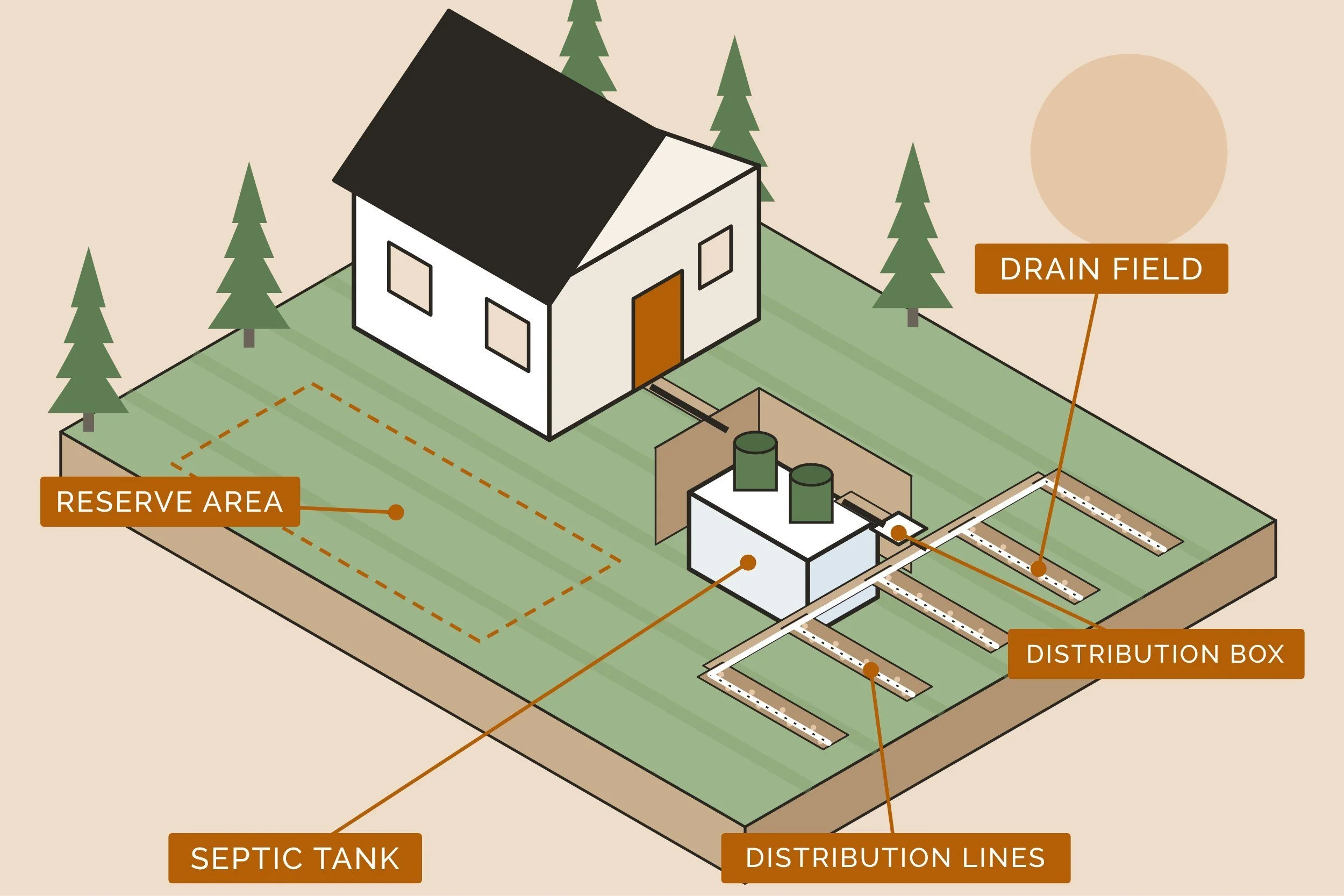
Everything from your drains runs to the septic tank. Solids sink to the bottom as sludge, and grease floats to the top as scum. The clearer liquid in the middle leaves through an outlet filter to a distribution box. The box splits it among perforated pipes in gravel trenches. That’s the drain field, and the soil under the lawn does the final treatment.
Septic isn’t only a rural thing. Public Health counts more than 85,000 septic systems in King County. Nearly 40,000 of them are inside the urban part of the county, and many are past their intended life span.
- 1Scum: Grease and light solids float on top
- 2Liquid: The middle layer moves on through the filter
- 3Sludge: Heavy solids settle; pumping removes them
- 4Lids and risers: Access for every inspection and pumping
- 5Filter: Keeps solids out of the drain field
| System | What it is | Inspect | Who inspects (King County) |
|---|---|---|---|
| Gravity | Tank plus a drain field fed by gravity | Every 3 years | You, a licensed pumper or a licensed maintainer |
| Pressure, mound or sand filter | A pump pushes effluent to the field | Every year | Licensed maintainer |
| Brand-name treatment unit | ATUs, Glendon, AdvanTex, subsurface drip | Every year, or more often if the maker says | Licensed maintainer |
Inspection timing is the state minimum (WAC 246-272A-0270); who may inspect is King County’s rule (Title 13, Table 13.60-1). Your record drawing says which system you have.
Planting
What to plant over a septic drain field
Grass is the best cover; the state Department of Health and King County both say so. After grass, pick low plants with shallow roots that don’t need much water. Roots go where the water is, and a drain field is the wettest ground in the yard.
- 1Drain field: Lawn and low groundcovers only
- 2Reserve area: Keep it open for a future drain field
- 3Tank lids: Leave them reachable; risers help
- 4Tree: 30 feet or more from the drain field
- 5Drive, patio, hot tub: Off the tank, field and reserve
The rules that come with it
A few rules come with it. No vegetable garden on or near the drain field or the reserve area. No plastic sheeting, bark, gravel or fill on top, and no reshaping the ground; King County allows up to 2 inches of topsoil. No ponds, and no water-loving trees or plants. The Tacoma-Pierce County Health Department draws the clearest line on trees. Never plant one in the drain field or within 30 feet of it, and no shrubs over it.
Groundcovers for sun
Kinnikinnick, carpet heather, bugleweed, soapwort, stonecrop (sedum)
King County and Tacoma-Pierce listsGroundcovers for shade
Bunchberry, sword fern and other ferns, sweet woodruff, wild ginger, wintergreen, mosses
King County list, from WSU ExtensionGrasses
Lawn, fescue (including blue fescue), blue oat grass, ornamental grasses, wildflower meadow mixes
Mow it, water it lightlyFlowers
Columbine, blazing star, California poppy
Short, shallow-rooted, low-waterWant a garden? Put it somewhere else in the yard; my guide to what grows well in Seattle covers the rest.
Keep off
What to keep off the tank, drain field and reserve area
The soil needs air to do its job; King County puts it as a balance of oxygen and organisms. Weight squeezes the air out and can crack pipes, and extra water drowns the field. State rules require owners to protect the system and the reserve area, the spot saved for a future drain field. Protect them from cover, surface water, compaction and digging (WAC 246-272A-0270).
Planning a drain, a retaining wall or an addition within 30 feet of the system? Pierce County asks you to check with the health department first, and that’s good practice everywhere.
Inspecting and pumping
How often to inspect and pump a septic tank in Washington
Timeframe Gravity system: inspect every 3 years · other systems: every year
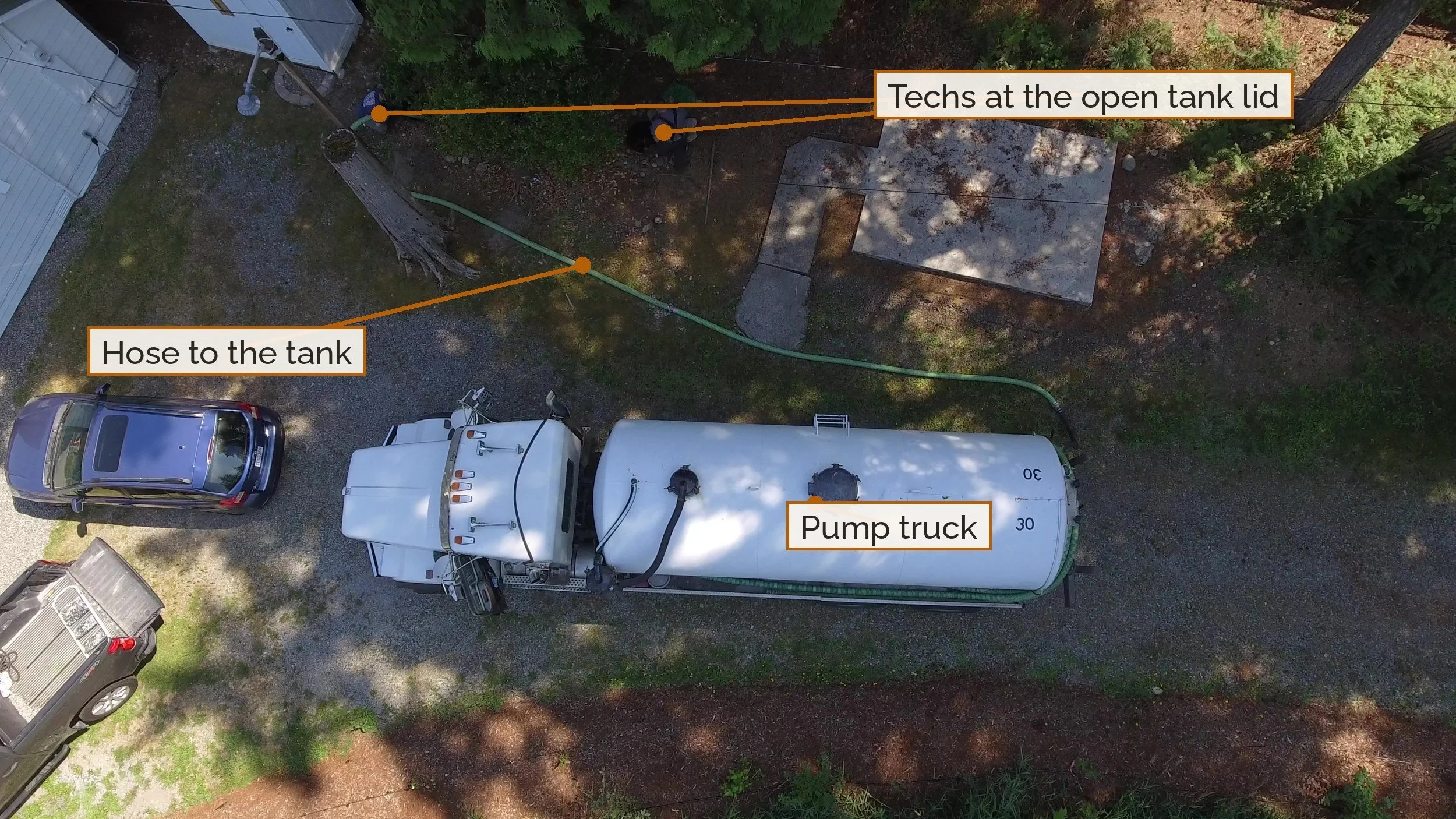
Inspect on schedule and pump when the inspection says so. Washington requires an inspection at least every three years for a gravity system and every year for everything else. A pumper empties the tank when the sludge and scum say it’s time (WAC 246-272A-0270). The EPA puts typical household pumping at every three to five years. King County points out that an inspection costs less than a pumping, so pumping only when needed saves money.
Who can inspect
In King County you can inspect a gravity system yourself; pressure, mound, sand filter and brand-name systems need a licensed maintainer (Title 13). With a garbage disposal, King County wants the tank’s solids checked every year, and the EPA says expect to pump more often. King County has offered a septic maintenance rebate of up to $500 that pays your certified pumper or maintainer directly; check whether it’s open.
Keep the reports
Every pumping and inspection report belongs in your home file. When you sell, state rules have you hand the buyer all available maintenance and repair records, and most counties keep them online at OnlineRME.
Bedrooms
Bedrooms set the size of your septic system
A septic system is approved for a number of bedrooms, and that number follows the house. King County designs for 150 gallons per bedroom per day, with a three-bedroom minimum, and counts bedrooms in an ADU too (Title 13). Adding a bedroom means a review first, and Form 17 asks every seller how many bedrooms the system is approved for.
I replaced the 1940s system at my own house in 2020. The county sized the new one for the two bedrooms I was adding: an eight-person system with three tanks. It came to about $40,000 all in, cleanup and new landscaping included. It took roughly 2,500 square feet of lawn and a big apple tree with it.
On a Hood Canal home in 2023, the record drawing showed a two-bedroom system. So two bedrooms is how the home was described, big office and all. The system also needed a repair before it could be pumped; the seller took care of it before closing. More on life out there in my Lake Cushman guide.
Trouble
Signs of a failing septic system, and what a fix costs
The Department of Health lists four signs. Call a certified septic pro, and report a failure to your county health department; state rules require it, and repairs need the county’s approval first.
What a fix costs
Costs run wide. King County’s rebate page puts a repair or replacement at around $15,000 to $40,000. Its 2026 permit fees add $619 for a single-family repair permit or $281 for a limited repair (fee schedule). Help exists: Craft3’s Clean Water Loan can cover design, permitting and installation. And King County’s list includes its Housing Repair Program, Habitat for Humanity’s Home Repair Program and USDA repair loans. King County’s septic expert line is 206-477-8177.
Sewer
Near a public sewer? When King County requires the switch
Inside King County’s urban growth area, the rule covers a home within 200 feet of a public sewer, measured along the roads and easements. That home has to abandon its septic system and connect when the system needs repair or replacement. The same goes when it has failed and a conforming system can’t be built, or when new construction affects it. The sewer utility has to allow the connection (Title 13, 13.04.050). New construction in the urban area connects too. Once you’re on sewer, the pipe from the house to the main is yours; that’s my side sewers guide.
Inside the urban growth area: abandon the septic system and connect, if the sewer utility allows it.
Selling
Selling a home with a septic system: what each county requires
Timeframe King County: a report from the last 12 months · statewide from February 1, 2027
In King County the inspection comes before the title can transfer, and the seller arranges it (Title 13, 13.60.030). Since April 1, 2025, a report from the previous 12 months counts if the home hasn’t sold since. But the county’s sales page still mentions 6 months in its waiver list. Ask your septic pro which applies to your file. Statewide, every county joins in on February 1, 2027.
- Step 1BookA licensed maintainer inspects
- Step 2FileReport to Public Health; $225 filing fee
- Step 3ReviewWithin 10 business days
- Step 4RecordSeller records Form 22U; buyer gets a copy
- Step 5CloseBuyer pays the $40 O&M fee
| County | What the seller needs | Timing | Cost |
|---|---|---|---|
| King | Inspection by a licensed maintainer, filed with Public Health; seller records Form 22U | Report from the last 12 months; review within 10 business days | $225 filing; buyer pays $40 |
| Snohomish | Report of Property Transfer: certified pro inspects, tanks pumped if required, seller applies | Starting November 1, 2026; valid 12 months; review up to 10 days | $245 (2026) |
| Pierce | Report of System Status: inspect and pump the tanks, then apply | Valid one year; review goal 10 business days; 90-day conditional option | Per health department fee schedule |
| Kitsap | Property Conveyance Inspection by the Health District | Apply 30 days or more before closing; reply within 7 working days | $295 for one system |
| Mason | O&M inspection report by a county-certified specialist | Within 12 months before the sale; a pumping report alone doesn’t count for gravity | Set by the provider |
| Rest of Washington | Inspection at transfer by an authorized inspector | Required statewide from February 1, 2027 | Varies by county |
What Form 17 asks
Form 17’s section 3 asks whether the system was permitted, and when it was last pumped and inspected. It asks how many bedrooms it’s approved for and whether it sits entirely on your lot. It also asks whether it needs service more than once a year. My Form 17 guide covers the deadlines, and property lines helps if the drain field might cross one.
Pricing a home with an older or failed system, and what to offer a buyer, are strategy questions; they live in my seller guide. If you’re prepping early, my pre-listing inspection guide pairs well with this.
Buying
Buying a home with a septic system
Your general home inspection stops at the tank. Under NWMLS Form 35, the sewer inspection covers only the line from the house to the system. The form advises a separate septic inspection contingency such as Form 22S (Form 35, Rev. 2/26). Read the seller’s Form 17 answers, pull the record drawing, and match the approved bedrooms to what the listing says.
Lenders
Lenders have their own rules. For a VA loan in Washington, King County notes the VA wants evidence that the system is acceptable. It must come from the local health authority (King County).
Before you offer
- Read Form 17, section 3Permit, last pumped, last inspected, bedrooms approved
- Pull the record drawingWhere the tank, field and reserve area are
- Check the bedroom countApproved bedrooms vs the listing
- Look up past reportsOnlineRME has pumping and inspection history
Under contract
- Septic contingencyNWMLS Form 22S, if you want your own inspection
- The county’s sale reportFiled by the seller’s septic pro
- King County closing itemsYour copy of Form 22U; the $40 O&M fee
- First reminderYour next inspection date, by system type
On an acreage purchase near Woodinville in 2021, the septic report described a 30-minute stress test with 150 gallons. It was a gravity system: no pump, so no mechanics to fail.
One closing detail: a home on septic may carry a small county septic program fee at closing, typically paid by the buyer. In King County it’s the $40 O&M program fee (2026). Whether to waive a septic contingency or ask for a repair is strategy; that’s in my buyer guide.
FAQ
Frequently asked questions about septic systems
What can I plant over my septic drain field?
Grass first, then low, shallow-rooted, low-water plants: kinnikinnick, carpet heather, bunchberry, ferns, sweet woodruff, wild ginger, fescues and wildflower meadow mixes. No shrubs, no trees within 30 feet, and no vegetable garden on or near it.
Can I put raised garden beds over a septic drain field?
No. King County says no vegetable garden on or near the drain field or reserve area. And no fill or reshaping beyond about 2 inches of topsoil. Put the beds elsewhere in the yard.
How far from a septic drain field can I plant a tree?
At least 30 feet, per the Tacoma-Pierce County Health Department, and skip water-loving trees. Roots follow water straight into the pipes.
Can I put a patio, shed or hot tub over a septic system?
No. Decks, patios, sheds, sport courts and parking stay off the tank, drain field and reserve area. Hot tub or pool water never drains onto the field.
How often should a septic tank be pumped?
When the inspection says the sludge and scum are high enough. The EPA puts typical household pumping at every three to five years; a garbage disposal shortens that.
How often does a septic system have to be inspected in King County?
A gravity system every three years; pressure, mound, sand filter and brand-name treatment systems every year, or more often if the maker says. You can inspect a gravity system yourself; the others need a licensed maintainer.
Who pays for the septic inspection when selling a house in Washington?
The county rules put the sale inspection on the seller in King County, and Snohomish County’s Report of Property Transfer is the seller’s application. The purchase agreement can split costs differently, so read your addendum.
Should I avoid buying a house with a septic system?
Not on that alone. A well-kept system with records, a current report and a bedroom count that matches the house is ordinary. A missing record drawing or no recent service is the thing to look into.
Can a homeowner inspect or install their own septic system in Washington?
Inspect, sometimes: King County lets owners inspect gravity systems, though other counties set their own rules. Design and installation need a permit, and the sale inspection in King County needs a licensed maintainer.
What are the new septic rules in Washington for 2027?
From February 1, 2027, the state requires a septic inspection at every property transfer by an inspector the local health department authorizes. King, Pierce, Kitsap, Mason and Snohomish counties already have sale programs.
How do I find where my septic tank and drain field are?
Find the record drawing. In King County, search kingcounty.gov/SepticRecords or OnlineRME; homes built before the early 1970s or systems installed without a permit may have no drawing on file.
Do septic additives help?
No. Washington bans additives unless the Department of Health approves them, and strong acids, bases and solvents are off limits too. Flush only toilet paper.
The bottom line
Keep the drain field soft, green and dry, inspect on schedule, pump when the report says so, and keep every receipt. Do that, and the system stays a quiet part of the house, and the sale paperwork takes a phone call instead of a scramble.
Sources
- WAC 246-272A-0270, Operation, monitoring and maintenance, owner responsibilities (eff. April 1, 2025), Washington State Legislature
- Board of Health Code Title 13, On-site Sewage (updated April 1, 2025), Public Health – Seattle & King County
- Sales and transfers of properties with on-site sewage/septic systems, King County
- On-site sewage/septic system owner requirements, King County
- Landscaping with an on-site sewage system, King County
- On-site sewage/septic system program, King County
- OSS permitting, certifications and drinking water fees, effective January 1, 2026, King County
- Financial assistance for on-site sewage/septic systems, King County
- Septic System Maintenance and Side Sewer Repair Rebate Program, King County
- Septic system records search, King County
- Do’s and Don’ts of Septic System Care (DOH 337-174, August 2025), Washington State Department of Health
- How to care for your septic system, U.S. EPA
- How to plant and build around your drainfield, Tacoma-Pierce County Health Department
- Report of System Status (selling your property), Tacoma-Pierce County Health Department
- New septic inspection requirement coming to Snohomish County, November 1 (April 18, 2026), Lynnwood Times
- Real estate: property conveyance applications, Kitsap Public Health District
- Septic maintenance requirements for property transfers, Mason County
- RCW 64.06.020, seller disclosure statement (Form 17), Washington State Legislature
- Form 35 Inspection Addendum, Rev. 2/26 (sample packet), NWMLS
- Clean Water Loans, Washington, Craft3
- Septic questions and transactions, 2020 to 2026, Brian Huie’s client files and his own homes