
Short answer: For most Seattle lawns, yes.
Real answer: A robot mower earns its keep on an open lawn within its rated size and slope, with an owner who’s fine trimming edges. Steep, shady or chopped-up yards are where they struggle.
Robot mower fit check
Will a robot mower work on your lawn?
Pick your lawn size, steepest slope, sky and layout. You’ll see the ratings to shop for, the boundary type, a price range, what it saves and a checklist. Nothing you enter leaves this page.
Your Seattle mowing year
Your checklist
Ratings use Husqvarna’s ±20% size band and slope specs. Prices: Consumer Reports’ 2026 ratings and my own receipts. Power: Husqvarna’s 13 kWh a month at full use for 0.8 acre, at about 16 cents per kWh. Planning numbers, not a quote.
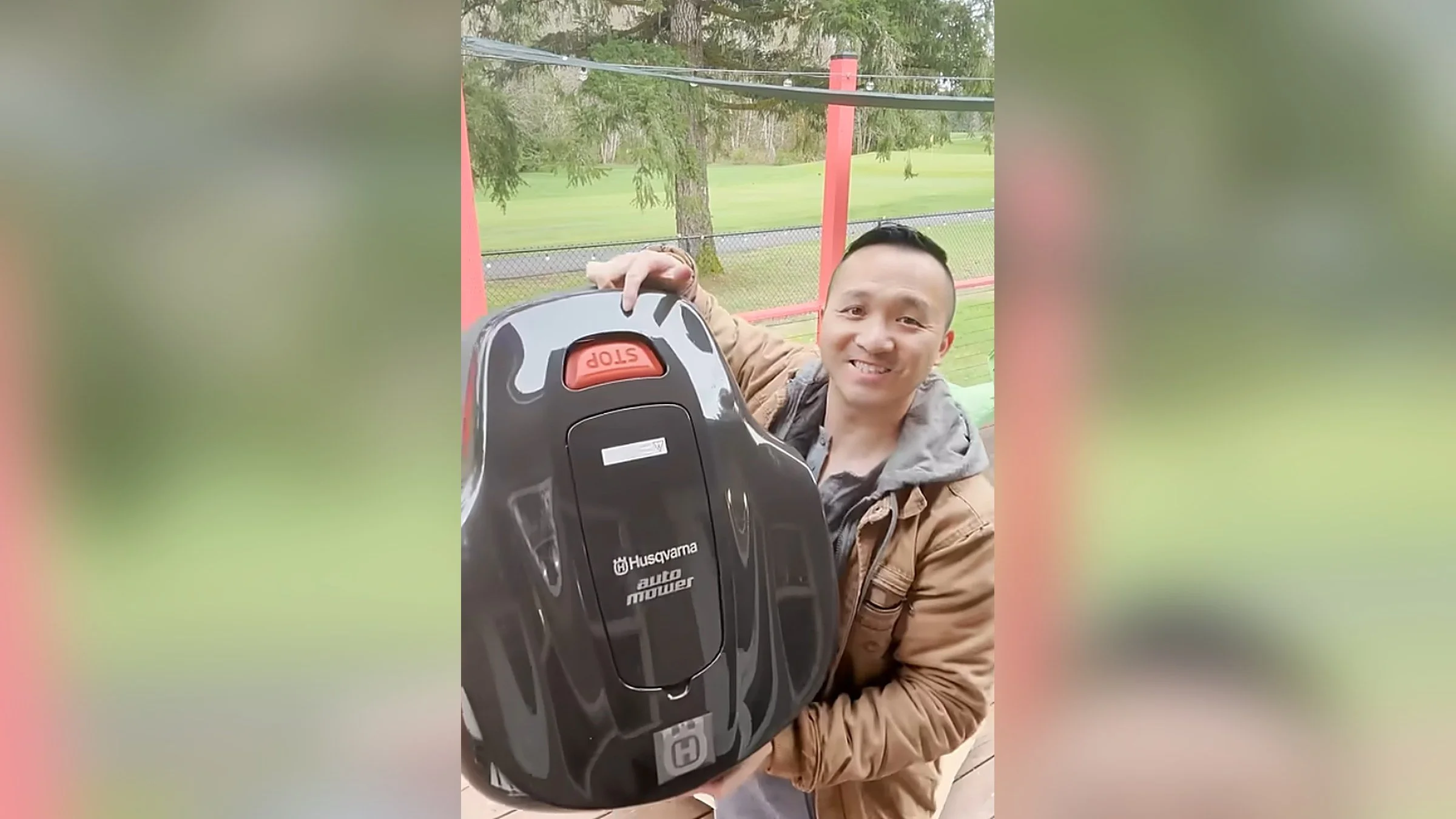
Clients ask me the same thing every spring: how do I keep the lawn green without mowing or chemicals? I’ve run a Husqvarna Automower 115H at home since 2024. Here’s what works in Seattle, and what doesn’t.
Same thing, other names: robot mower, robot lawn mower, robotic mower, robotic lawn mower and autonomous mower. Automower is Husqvarna’s brand name.
The basics
How a robot mower works
Small cuts, most days
A robot mower is a small battery mower that cuts on a schedule. It trims a little off the top most days instead of a lot once a week.
It drives in a random or planned pattern and leaves the fine clippings where they fall.
A boundary tells it where to stop
It needs a boundary so it knows where the lawn ends. Older and budget models follow a thin wire staked around the edge.
Newer models use satellite positioning, cameras or both. You draw the lawn on a map in an app.
Back to the dock
When the battery runs low, it drives back to its dock and charges. Then it goes back out on its own.
The big question
Is a robot mower worth it in Seattle?
What it costs
Consumer Reports rated robot mowers from about $800 to more than $2,500 in 2026. Boundary wire models can cost less.
I paid $659.50 for my Automower 115H in March 2024. Power is pocket change: Seattle City Light’s average is about 16 cents per kWh.
Crew math: 35 weekly visits a season, April to November. Robot power adds only a few dollars a season.
What it saves
Lawn crews cost real money. Angi’s national average is $123 per visit, with a normal range of $49 to $203.
I paid a helper $75 for a single mowing in June 2026. Weekly, April through November, that’s about 35 visits.
It’s cleaner air, too. One hour of a commercial gas mower makes as much smog-forming pollution as driving a new car about 300 miles (CARB).
Where it falls short
It won’t do everything. Most robots can’t cut tight to fences and walls, so you still trim the edges.
It also leaves patches where toys or sticks sit. Big, steep or shady lawns may need a pricier model or a person.
I bought my 115H in 2024 to stop losing weekends to the mower. It still runs most days from spring to fall. The one real headache has been the boundary wire.
Your yard
Will it work on your yard? Size, slopes and trees
Size: buy some headroom
Every model lists a rated lawn size. Husqvarna’s ratings carry a ±20% band, so buy a rating at least 20% above your lawn (Husqvarna).
Measure only the grass. Beds, patios and the driveway don’t count.
Slopes: inside the lawn and at the edge
Robots list two slope numbers: one for inside the lawn and a lower one at the boundary.
My 115H handles 30% inside the lawn and 15% at the edge. Husqvarna’s 430X NERA handles 50% inside and 25% at the edge.
Trees and tall walls
Satellite models need open sky. Husqvarna warns that dense trees with crowns over 13 feet across, or tall buildings, can block the signal (Husqvarna).
Seattle yards often sit under big firs and maples. There, a boundary wire or a camera-assisted model is the safer bet. For slopes too steep to mow, WSU Extension suggests ground covers instead of lawn.
Boundaries
Boundary wire or wire-free
Boundary wire
A wire model follows a thin cable pinned at the lawn’s edge. It works under trees, needs no internet for the boundary, and costs less.
The trade-off: the wire can be cut by an edger, a shovel or a critter. A break stops the mower until you find it.
Boundary wire
- Works under big trees
- No internet needed for the boundary
- Usually cheaper
- A break stops the mower
Wire-free (satellite, camera)
- Draw zones in an app
- No wire to cut
- Needs open sky and Wi-Fi or cellular
- Camera backup helps under trees
Wire-free: satellite and camera
Wire-free models draw the boundary in an app. Satellite models (often called RTK) are accurate to inches with open sky.
Some add a camera to keep mowing where the signal drops. Wire-free models also need Wi-Fi or cellular coverage across the lawn (Husqvarna).
Setup
Setting one up
Timeframe My setup: about 45 minutes on a simple lawn. Larger or wired yards take longer.
Five steps
Setup takes a weekend morning, not a contractor. You place the dock, set the boundary, connect the app and pick a schedule.
Setting one up is easier than installing holiday lights. Mine took about 45 minutes on a simple lawn.
- Step 1Walk the lawnNote beds, trees, gates and edging paths.
- Step 2Place the dockLevel, near an outlet, open in front.
- Step 3Set the boundaryStake the wire, or draw it in the app.
- Step 4Connect the appSet a PIN, cut height and zones.
- Step 5Pick a scheduleDaylight hours, more in spring.
Plan the wire before you stake it
Walk the lawn first. Note the beds, the trees, the gate and anywhere an edger runs along a path.
Keep the wire a little in from hard edges, and away from where you dig. That one choice saves the most headaches later.
Seasons
A Seattle robot mowing year
Spring is the busy season
Seattle Public Utilities’ lawn calendar puts the heavy mowing in April and May (SPU natural lawn care guide).
That’s when a robot pays off most. It keeps up while the grass grows fastest.
Summer: let it go golden
In summer, grass slows. The same calendar says to water about 1 inch a week, or let the lawn go golden and dormant.
A dormant lawn needs little mowing. Cut the robot’s schedule back, and it stays out of the way.
Fall into winter
In fall, the rain returns and growth picks up again. Mow until it slows, then put the robot away for winter.
The lawn
What it does for the lawn
Grasscycling, every day
Daily trims leave tiny clippings that break down fast. That’s grasscycling, and it feeds the lawn nitrogen for free (WSU Extension).
A lawn can make about 300 pounds of clippings per 1,000 square feet a year (City of Kirkland). A robot leaves them all on the lawn.
Height and the one-third rule
Local guides say to mow at 2 to 3 inches and never cut more than one-third of the blade at once. Daily trims make that easy.
Check the maximum cut height before you buy. Some robots top out under 3 inches.
Fewer chemicals
Healthy, dense turf crowds out weeds. Seattle’s natural lawn care guide says to skip weed and feed, and I haven’t used fertilizer or weed killer since.
Even the dandelions barely show up, and when they do, the chickens eat them.
Safety
Kids, pets, wildlife, noise and theft
Kids and pets
Robots stop their blades when lifted or tipped. Consumer Reports still recommends keeping children off the lawn while one runs.
Pick up toys, hoses and dog bones first. A clear lawn mows cleaner, too.
Wildlife: mow in daylight
Research in Europe found robot mowers can injure small animals that freeze instead of running (Leibniz-IZW). Here that means frogs, snakes and fledglings, so schedule mowing in daylight.
Noise
Seattle’s residential noise limit at the property line is 55 dB(A) by day and 45 dB(A) at night (SDCI Tip 137).
Night means 10 p.m. to 7 a.m. on weekdays, and until 9 a.m. on weekends and holidays. Husqvarna rates the 430X NERA at 56 dB(A).
Theft
Most robots need the owner’s app and a PIN to work. Many also have a lift alarm and GPS tracking.
Upkeep
Upkeep: blades, battery and winter
Blades
Robot blades are small razor blades. Husqvarna says to replace long-life blades every 6 to 8 weeks, and to never sharpen and reuse them (Husqvarna).
- Every 6 to 8 weeksBladesSwap long-life blades; don’t sharpen them.
- Weekly in seasonCleanGrass off the wheels and deck, power off.
- Every 2 to 5 yearsBatteryReplace when it docks more often.
- Each fallStoreCharge full, store indoors above freezing.
Battery
Batteries usually last 2 to 5 years (Husqvarna). A mower returning to charge more often is the first sign.
Winter storage
Before winter, clean it, charge it full and store it indoors, dry and above freezing. The boundary wire can stay in the ground (Husqvarna).
2026
Buying one now: the 2026 FCC change
What changed in July 2026
On July 28, 2026, the FCC added foreign-made “advanced robotic devices” to its Covered List (Cooley).
The definition reaches many robot mowers. New foreign-made models can’t get the FCC approval they need for U.S. sale (Consumer Reports).
What it means for you
Mowers you already own keep working. Models approved before that date can still be sold.
What changes is next year’s lineup. Fewer new models may reach U.S. shelves, so check that a model is sold here before you plan around it.
Selling and buying
Robot mowers when you sell or buy a home
Selling
A robot mower is usually treated as personal property, like a grill. If it stays with the house, write it into the purchase agreement.
Before closing, remove it from your app account or hand over the PIN. Leave the wire map if you have one.
Selling
- Decide if the mower stays
- Write it into the purchase agreement
- Pause it for showings
- Hand over the app access
Buying
- Ask if it conveys
- Ask the battery’s age
- Get the PIN before closing
- Find the wire before you dig
Buying
Ask if the mower stays and how old the battery is. A wired lawn may have cable just under the grass, so ask before you dig or edge.
Plan the app transfer before closing day, so the PIN isn’t a mystery in April.
FAQ
Frequently asked questions about robot mowers
Are robot mowers worth it?
Usually, for an open lawn within the mower’s size and slope ratings. You trade an upfront cost for hours back each week. Steep, shady or chopped-up yards are harder.
How much does a robot mower cost?
Consumer Reports rated models from about $800 to more than $2,500 in 2026. Boundary wire models can cost less. I paid $659.50 for mine in 2024.
Do robot mowers work in the rain?
Many are built for it. My Husqvarna is rated IPX5. Still, soggy ground can rut, so trim the schedule in the wettest weeks.
Can a robot mower handle hills?
Check two ratings: the slope inside the lawn and the lower slope at the edge. Many handle 30% inside; some handle 50%. Above that, plant ground cover.
Do I need a boundary wire?
Not always. Wire-free models use satellites, cameras or both, but they need open sky and a network. Under big trees, a wire is often more reliable.
How long do robot mowers last?
The battery usually lasts 2 to 5 years, then it can be replaced. Blades are swapped every couple of months in season.
Do robot mowers get stolen?
They can be picked up, but most need the owner’s app and PIN to run. Many add a lift alarm and GPS tracking.
Are robot mowers safe around kids and pets?
Blades stop when the mower is lifted or tipped. Keep kids off the lawn while it runs, and schedule it in daylight for wildlife.
What do I do with it in winter?
Clean it, charge it full and store it indoors above freezing. The boundary wire can stay in the ground.
Does a robot mower stay with the house when I sell?
It’s usually personal property. If it stays, say so in the purchase agreement and hand over the app access.
The bottom line
A robot mower isn’t a gadget. It saves time, cuts chemicals and keeps turf healthy without the noise of a gas mower.
Match the model to your lawn’s size, slope and sky, then let it work. Mow less, live more.
Next: my month-by-month maintenance checklist, what grows well in Seattle, or backyard privacy ideas.
Sources
- Consumer Reports, Best Robot Lawn Mowers (updated Sept 19, 2026), price range, time saved, edges, safety, FCC ban
- Husqvarna, Automower 115H specifications (read November 2026), 0.4 acre ±20%, 30% inside, 15% at boundary, boundary wire, IPX5
- Husqvarna, Automower 430X NERA specifications (read November 2026), 13 kWh a month at maximum use, 56 dB(A), 50% and 25% slopes
- Husqvarna, How to plan a wire-free installation (read November 2026), open sky, trees over 13 feet across, network coverage
- Husqvarna, Complete winter storage guide (read November 2026), store indoors above freezing, wire stays in the ground
- Husqvarna, Automower battery lifespan (read November 2026), 2 to 5 years
- Husqvarna, Automower care and maintenance tips (read November 2026), blade replacement every 6 to 8 weeks
- Leibniz-IZW via EurekAlert, robotic mowers and hedgehogs, small-animal injuries, daylight schedules
- Cooley, FCC Covered List adds advanced robotic devices (updated Aug 27, 2026), July 28, 2026 action, already-authorized devices
- Angi, average prices for mowing lawns (2025 data), $123 per visit, $49 to $203
- Seattle Public Utilities, Natural Lawn Care for Western Washington (Tacoma reprint), lawn calendar, 2 to 3 inches, water or dormant
- WSU Extension King County Master Gardeners, Tip Sheet 11: Lawns (Feb 2025), grasscycling, mowing height, ground covers on slopes
- City of Kirkland, Grasscycling, about 300 pounds of clippings per 1,000 square feet a year
- Seattle SDCI, Tip 137, 55 dB(A) day, 45 dB(A) night, residential
- Seattle City Light, rates, average about 16 cents per kWh
- California Air Resources Board, Small Off-Road Engine fact sheet, gas mower emissions vs a car