
Short answer: on a Seattle hillside, the house is only half the inspection.
Real answer: A geotechnical inspection is a licensed engineer’s look at the ground under and around a home. It covers the slope, the soil, the water and the walls holding it all in place. A home inspector doesn’t evaluate any of that. In Seattle, about 8.4% of the city is mapped as landslide-prone, and the city requires a geotechnical report before building in those areas. If you’re buying, owning or building on a slope, check the free hazard maps first. Then call a geotechnical engineer before you sign, dig or cut.
Slope and soil checker
Does this home need a geotechnical engineer? Check your slope, your clues and your maps
Pick your situation and what you see on the lot. Add a rise and run if you can measure the slope. You’ll get a straight answer, what each clue may mean, the free maps for your area, what the season means for your slope, and a plan you can tick off.
What your clues may mean
Free maps and records to check
Your plan
Based on Seattle’s Environmentally Critical Areas code (SMC 25.09), SDCI’s Director’s Rule 5-2016 and landslide guidance, King County and state hazard mapping, and Washington’s home inspection standards. General information, not an engineering opinion: only a licensed engineer who visits the site can tell you whether ground is stable. If ground is moving or anyone is in danger, call 911.
Seattle view homes are worth every switchback on the drive home. They also sit on hills built from glacial sand, silt and clay, with a winter that can deliver weeks of rain. I recommend a geotechnical engineer for nearly every hillside home my buyers consider, and I’ll be honest: most visits end with good news. That’s the point. A few hours with the right engineer lets you enjoy the view instead of watching the yard. Everything a regular home inspection covers is in my home inspection guide.
The basics
What a geotechnical inspection is, and what a home inspection skips
What the engineer studies
Geotechnical engineers study how ground behaves. How steep can a slope stand in a given soil? Where does water move underground? Does the foundation sit on firm material? What will a wall or a new addition do to the hill? For a home buyer or owner, the work usually starts as a site visit. It can grow into a stamped report with borings or test pits when a permit is involved.
What the home inspector skips
Washington’s home inspection standards leave the ground out on purpose. Inspectors aren’t required to inspect retaining walls and other structures detached from the house. Their pre-inspection agreement must say soil isn’t investigated unless agreed in writing. A good inspector will note cracks, sloping floors or water and refer you on. The referral usually ends up here.
| Who | Looks at | Call when |
|---|---|---|
| Home inspector | The house: roof, structure, systems, interior, the grading right at the foundation | Every purchase, and every few years as an owner |
| Structural engineer | Framing, beams, foundations and how loads move through the house | Cracks, sagging or a wall you want to remove |
| Geotechnical engineer | Soil, slopes, groundwater, retaining walls and what the ground does to the foundation | A slope above or below, a wall holding soil, a mapped hazard area, settling |
| Engineering geologist | The geology behind a landslide: old slides, layers, how the hill formed | A big or complex slope; Seattle can require a licensed geologist’s review |
The engineer
What a geotechnical engineer actually does
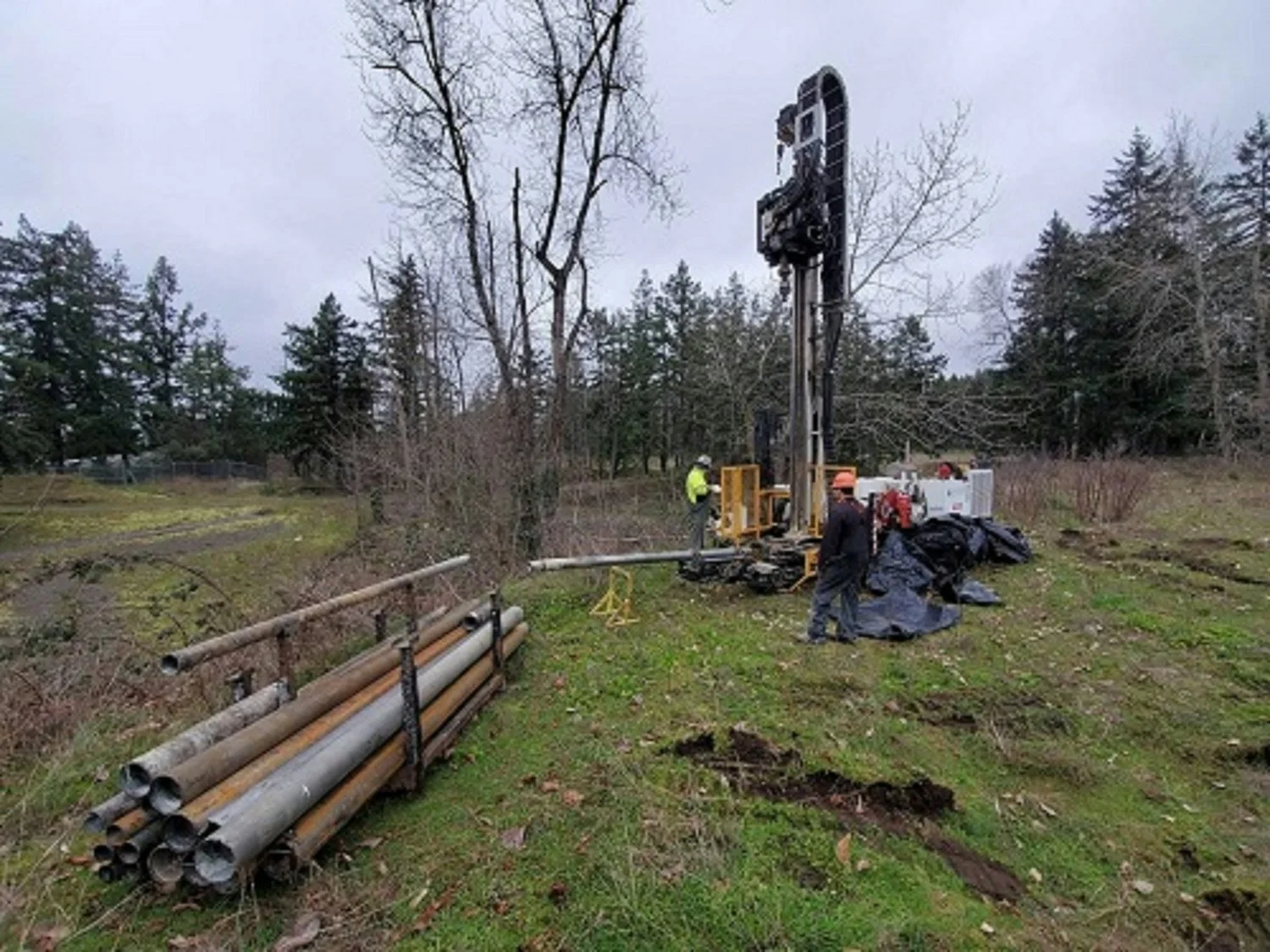
Most of what I’ve seen falls into 2 levels. For a purchase, the engineer does a visual assessment. A permit asks for much more, and Seattle spells out what goes into that report in its rule for geotechnical engineers.
- 1Desk review. Geologic and soils maps, the city or county hazard layers, Seattle’s 2000 landslide study and any slide history on file.
- 2Site walk. The slope above and below, retaining walls, drainage, cracks in the ground and the house, trees that lean or bow.
- 3Measure. How level the floors and foundation are, and how steep the slope is compared with what that soil usually holds.
- 4Explore, when a permit needs it. Borings or test pits and lab tests of the soil. Drilling usually isn’t practical during a sale.
- 5Report. Findings and recommendations: drainage fixes, wall repairs, where to build, what to avoid, and a statement on stability.
- 6Monitor. On a permitted project, the engineer inspects during construction and signs a final report before Seattle approves occupancy.
| Visual assessment | Permit-level report | |
|---|---|---|
| When | During a purchase or as an owner with a question | Additions, ADUs, walls, grading or drainage in a hazard area |
| What it includes | Maps, a site walk, floor and slope checks, a short letter | Everything at left plus borings or test pits, lab tests, analysis, a stamped report |
| Time on site | A few hours; a large, complex lot took 3 to 4 in my files | Days, plus drilling and lab time |
| Who signs | A licensed engineer | In Seattle, a licensed civil engineer with geotechnical experience |
Seattle’s rule asks a lot of the engineer. It takes a licensed professional engineer (civil) with at least 4 years of geotechnical experience and a signed, stamped report. The report needs a statement that every part of the site and neighboring property the work touches will stay stable during and after construction.
Seattle hazard areas
Seattle’s landslide-prone areas and steep slopes, in plain English
Seattle regulates hazard ground through its Environmentally Critical Areas code, SMC 25.09. The city adopted its first permanent critical areas policies and code in 1992 and has amended them several times since. If your house was built earlier, it wasn’t built under today’s geotechnical rules. The city itself says it’s unclear how many older properties meet current standards.
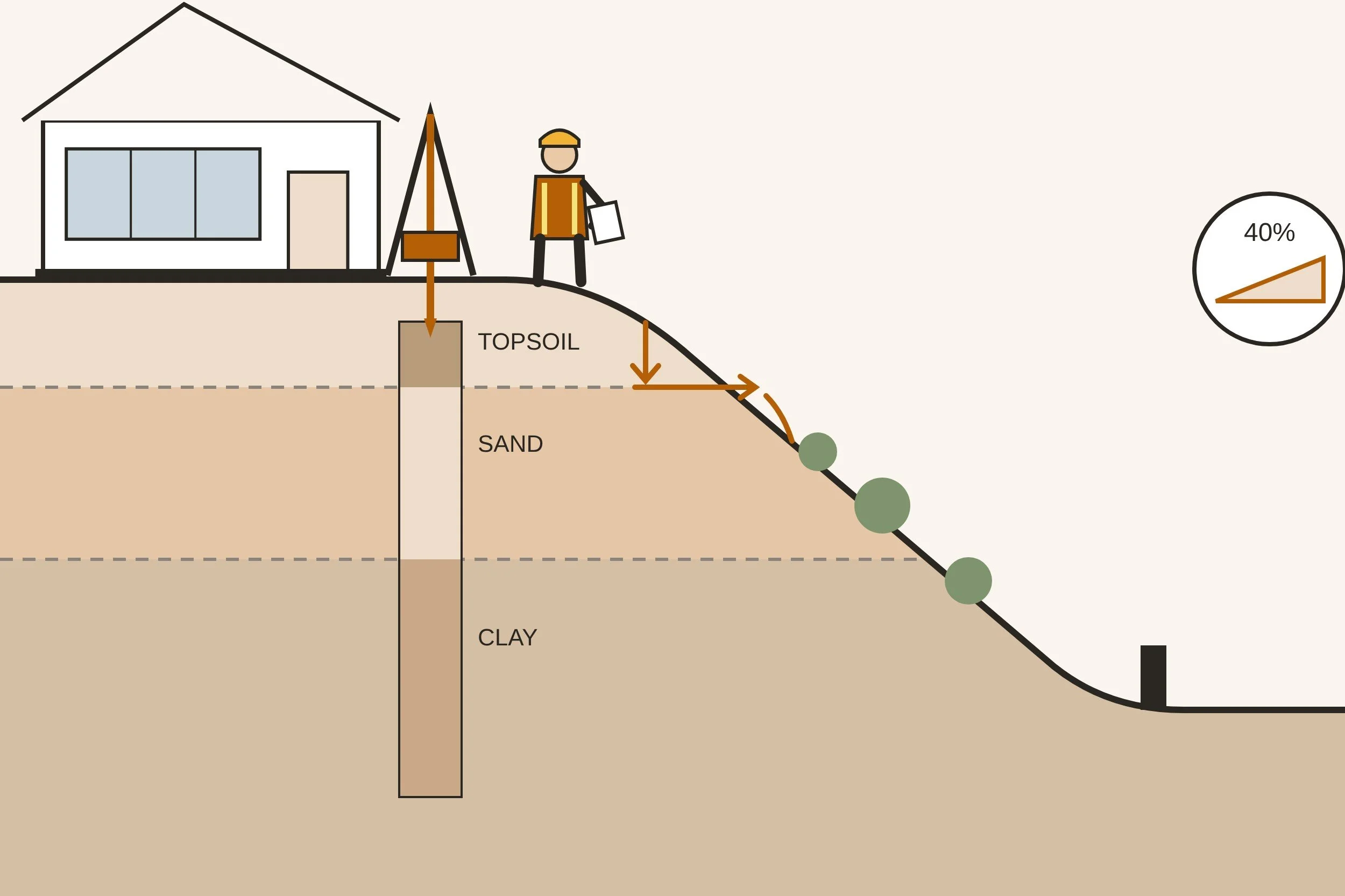
SDCI’s own geotechnical group sums up why slides happen in 4 words: topography, geology, water and people. In their words, it’s water, water, water. About 70% of Seattle’s slides are shallow and often tied to human activity like stormwater; about 20% are deep-seated. Most happen between late October and late March.
- 1Top and toe. Seattle measures a slope between the break at its top and the break at its toe, averaged over at least 10 feet of rise.
- 240% is steep. 10 feet up over 25 feet across, about 22 degrees. Steeper than that over 10 feet of rise is a steep slope area.
- 3Water on clay. Rain soaks through sand, stops on clay and seeps out of the slope. Saturated ground is when most slides happen.
- 4The wall at the toe. It holds the hill back. Cutting into a toe or loading a wall without engineering is how good slopes go bad.
| Area | What it means | How it’s found |
|---|---|---|
| Steep slope area | A slope of 40% or more over at least 10 feet of rise. That’s 10 feet up in 25 feet across, about 22 degrees | Measured on the ground from toe to top; the city map is advisory |
| Known slide area | Ground with a recorded landslide or signs of one, such as scarps and hummocky ground | City records and the 2000 Seattle Landslide Study |
| Potential slide area | Ground the 2000 study flagged for its geology, such as water-bearing sand sitting on clay | The city’s ECA map layer |
| Liquefaction-prone area | Loose, low-density sandy soils with shallow groundwater that can lose strength in an earthquake | The city’s ECA map layer |
| Peat settlement-prone area | Old wetland soils full of peat that sink when loaded or when groundwater drops | Mapped by the city; a project report won’t move the boundary |
Where Seattle has had the most slides: Alki Avenue in West Seattle and Perkins Lane in Magnolia, with more than 100 documented each. On January 7, 2022, heavy rain sent a Perkins Lane house 15 to 20 feet off its foundation. Perkins Lane residents still manage the water: most of the neighbors there use dewatering wells, as one told KUOW that month.
Free maps
How to check whether a home sits in a slide area
You can do most of the first pass from your couch for free. None of these maps replaces an engineer, but they tell you whether to call one.
- 1Look up the address on Seattle’s SDCI GIS map and turn on the Environmentally Critical Areas layers. Some known slides there link to more detail.
- 2Outside Seattle in King County, open King County iMap, choose the layer list, then Environmentally Sensitive Areas, for landslide and steep slope layers.
- 3Anywhere in Washington, check the state’s Geologic Information Portal landslide layers. The state notes that not every slide is mapped, so a blank map isn’t a clean bill of health.
- 4Read the title report. Covenants and notices tied to slopes get recorded; I’ve seen a 1991 slide-area covenant and a recorded notice of an ECA violation.
- 5Read the seller’s Form 17: settling, slippage or sliding (Structural, 4E) and drainage, fill, landslide damage and critical areas (Environmental, 7A to 7D).
- 6Walk the lot after a hard rain. Water tells the story: where it runs, where it stands and where it comes out of the hill.
Warning signs
Warning signs on a hillside lot
- Cracks in the groundNew cracks along a slope, or a step or drop in the lawn, can mean the ground is moving. Call an engineer.
- Leaning or bowed trees, fences and wallsTrees that curve at the base or a fence that starts to tilt show slow movement over years.
- Water where it shouldn’t beSeeps, springs or soggy ground on a slope, water at the base of a wall, blocked weep holes.
- A wall doing too much workBulging, leaning or cracked retaining walls and rockeries, especially ones holding up a driveway or a house.
- Doors that stick and new cracks insideOne sticky door is weather. New diagonal cracks, sloping floors and gaps that grow are worth a look.
- Fill and yard waste on the slopeDumped soil, clippings or debris add weight and trap water exactly where it hurts most.
If the ground is moving fast or anyone is in danger, call 911. In Seattle, SDCI takes reports of a building affected by a slide at 206-615-0808. Seattle Public Utilities takes utility problems at 206-386-1800. You may also need a private geotechnical and structural engineer.
Owning a slope
Living on a slope: drainage, walls, trees and permits
Most of what keeps a hillside lot healthy is unglamorous water management. SDCI’s geotechnical group publishes a short do and don’t list, and it matches what I see on good and bad lots alike.
| Do | Don’t | |
|---|---|---|
| Water | Keep drains, pipes and street drains clear; check them before winter and during storms | Send roof or yard water onto a slope, or run permanent irrigation in a landslide-prone area |
| Plants | Leave stumps in the ground; their roots keep holding | Clear vegetation on a slope without a replanting plan |
| Soil | Keep fill and yard waste off the slope | Cut into the toe of a slope |
| Walls | Keep weep holes open | Build walls or rockeries without a permit |
- Retaining walls in Seattle.No permit only if the wall is 4 feet or lower from the bottom of the footing, the parcel has no ECA, and the wall won’t harm neighboring property. On a parcel with an ECA, a wall of any height needs to meet the ECA requirements or an exemption.
- Rockeries.A permit for any rockery over 4 feet; rockery designs come from a geotechnical engineer or follow the city’s prescriptive standard.
- Landslide-prone areas.SDCI requires a permit for grading over 25 cubic yards, for all retaining walls and for all drainage installations there.
- Steep slopes.Development must stay out of steep slope areas and their buffers unless the city grants an exemption or relief.
- The wet season.Seattle generally doesn’t allow excavation in landslide-prone areas from November 1 through March 31 without an engineer’s analysis and the city’s approval.
- How far from the line.Setbacks and fence heights are their own rules; my setbacks guide covers them, and my property lines guide shows how to find the line itself.
Buying and selling
Buying or selling a hillside home
Washington doesn’t require a geotechnical inspection to buy or sell a house, and most buyers don’t get one. I recommend one for nearly every hillside home my buyers consider. In my experience it rarely finds anything critical, and a few hours of peace of mind is worth it on a hill.
Timeframe Usually booked about a week out; the visit fits in a normal inspection period
In practice, a geotechnical engineer is often booked about a week out, longer than most home inspectors. The visit fits inside a normal inspection period. A buyer’s inspection contingency, NWMLS Form 35, lets the buyer add specialist inspections. How to time them in a competitive offer is strategy, and it lives in my buyer guide’s inspection chapter.
Sellers answer Form 17 from what they actually know. I tell sellers to check “no” only when they’re sure and “don’t know” when they don’t. I tell buyers not to read too much into a “don’t know”: ask the question instead. Seller prep for a hillside listing lives in my seller guide’s prep chapter.
A slope story from my files
A few years ago, an updated title report on one of my buyers’ purchases showed a recorded city notice. The seller had cleared vegetation and worked on retaining walls on a steep slope without approval. Escrow said the deal couldn’t close without clear title, and the city said the buyer would be buying the violation along with the house. Nobody could price the fix until a plan was approved, anywhere from $10,000 to $150,000. The fix that worked came from a geotechnical engineer: remove the lower wall, replant the slope with sword ferns, and sign off on the result. The city’s estimate for that kind of restoration was about 6 months. The lesson I took: on a slope, unpermitted walls and clearing aren’t just a disclosure question, they can stop a closing. My unpermitted work post covers the rest.
Insurance
Does homeowners insurance cover landslides?
Usually not. Washington’s insurance commissioner says a standard homeowner policy won’t cover land movement or a landslide caused by rain runoff, snowmelt, flooding or earthquakes. Seattle’s own hazard plan says the same.
- Difference in conditions (DIC).A separate policy for the structure that can include landslides, mudflows, earthquakes and floods, often through a surplus lines insurer.
- Contents coverage.Some insurers add earth movement coverage for belongings, not the building.
- Flood insurance.Bought separately; it may cover some water-driven earth movement such as mudflows.
- Earthquake insurance.Bought separately or added on. In one of my sales, the insurer asked for the lot’s slope percentage before quoting a hillside home; the tool above can estimate it.
Ask your agent or broker what each policy excludes before you buy it. The commissioner’s consumer advocacy line is 800-562-6900.
FAQ
Frequently asked questions about geotechnical inspections
How much does a geotechnical inspection cost?
For a visual assessment during a purchase, my clients have generally paid under $1,000, though my latest numbers are a few years old. A permit-level report costs more because it adds borings or test pits, lab work and analysis. Ask for a written scope and quote.
What does geotechnical testing involve?
For a permit: borings or test pits to see the soil layers and groundwater, and lab tests of soil samples. For a purchase, the engineer usually relies on maps, a site walk and floor and slope measurements instead.
Is a geotech report the same as a soils report?
In everyday use, yes. Seattle’s own rule uses both names for the engineer’s report on soil and slope conditions.
Can a civil engineer prepare a geotechnical report?
In Seattle, the report must come from a licensed professional engineer (civil) with at least 4 years of geotechnical experience, signed and stamped. Check any Washington license on the state lookup.
Does a home inspection check the slope?
Not really. Washington’s standards don’t require inspectors to inspect retaining walls detached from the house, and soil isn’t investigated unless agreed in writing. Inspectors do report cracks, water and sloping floors and refer you to a specialist.
Is it a good idea to buy a house on a slope?
It can be a great one. Views, light and privacy come with the hill. Check the hazard maps, read Form 17 and the title report, and have a geotechnical engineer walk the lot before you’re committed.
What problems do houses on hillsides have?
Drainage first, then retaining walls, settling foundations and slope movement. In Seattle, water is the most common trigger, and people changing the slope played a part in 84% of the city’s 20th-century slides.
How do I know if my house is in a landslide area?
In Seattle, check the ECA layers on the SDCI GIS map. In the rest of King County, use iMap’s Environmentally Sensitive Areas layers. Statewide, use the DNR Geologic Information Portal. Then ask an engineer; maps miss things.
What counts as a steep slope in Seattle?
A slope of 40% or more over at least 10 feet of rise, measured from its toe to its top. That’s about 22 degrees.
Do I need a permit for a retaining wall in Seattle?
Usually. You can skip it only if 3 things are true. The wall is 4 feet or lower from the bottom of the footing, and the parcel has no environmentally critical area. The wall also won’t harm neighboring property.
When do Seattle landslides happen?
Mostly between late October and late March, after the ground is soaked. Many can happen within a few days of heavy rain or fast snowmelt.
Does homeowners insurance cover a landslide?
A standard Washington policy usually doesn’t. Separate difference in conditions, flood and earthquake policies can fill some of the gap.
The bottom line
On a Seattle hillside, the house is only half the inspection. Check the free hazard maps, read Form 17 and the title report, and keep water off the slope. Bring in a licensed geotechnical engineer before you buy, build a wall or dig.
If you’re looking at a view home or something on your slope has you wondering, send me a note. I’m glad to pull the maps with you and point you to the right engineer.
Sources
- Seattle Municipal Code Chapter 25.09, Regulations for Environmentally Critical Areas, City of Seattle
- Environmentally Critical Areas (ECA) Code, Seattle Department of Construction and Inspections
- Environmentally Critical Areas Update: Background (1992 code and amendments), Seattle Department of Construction and Inspections
- Seattle Landslides: What You Need to Know (December 2023), SDCI Geotechnical Group
- Director’s Rule 5-2016, General Duties and Responsibilities of Geotechnical Engineers, Seattle Department of Construction and Inspections
- Tip 327A, ECA Exemptions and Relief from Prohibition on Steep Slope Development (updated May 29, 2025), Seattle Department of Construction and Inspections
- Tip 325, Environmentally Critical Areas: Peat Settlement-Prone Areas (updated March 31, 2022), Seattle Department of Construction and Inspections
- Retaining Walls and Rockeries, Seattle Department of Construction and Inspections
- Tip 321, Rockeries, Seattle Department of Construction and Inspections
- ECA Steep Slope map layer, City of Seattle GIS
- Seattle Hazard Identification and Vulnerability Analysis: Geologic Hazards (landslides), City of Seattle Office of Emergency Management
- Landslide mapping, King County
- Landslides, Washington Geological Survey, Department of Natural Resources
- Washington Geologic Information Portal, Washington Department of Natural Resources
- Seattle Area, Washington landslide monitoring, U.S. Geological Survey
- Open-File Report 2006-1064, rainfall thresholds for landslides in Seattle, U.S. Geological Survey
- Landslide insurance, Washington State Office of the Insurance Commissioner
- RCW 64.06.020, Seller disclosure statement (Form 17), Washington State Legislature
- WAC 308-408C-050, Home inspection pre-inspection agreement (soil excluded unless agreed), Washington State Legislature
- WAC 308-408C-080, Exterior (retaining walls not required), Washington State Legislature
- RCW 18.220.010, Geologists: definitions, including engineering geologist, Washington State Legislature
- Landslide in Magnolia neighborhood (January 7, 2022), Seattle Fire Department
- The inescapable power of water on a landslide-prone street, KUOW