
Short answer: one round, whole offer, and rarely a second chance.
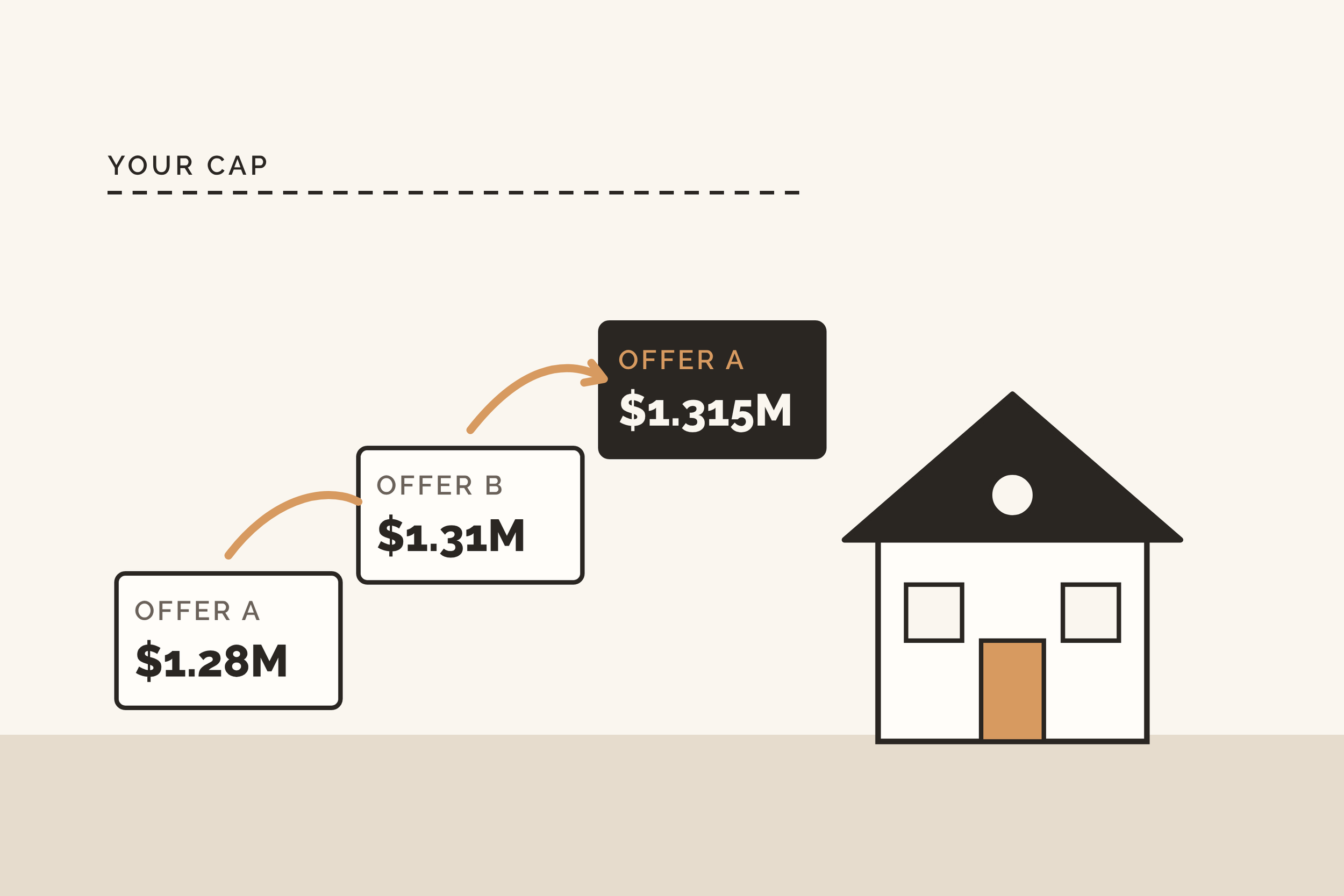
Real answer: A bidding war happens when a seller has more than one offer at the same time. In Seattle it usually plays out on an offer review date. Buyers submit their best terms once, and the seller weighs the whole offer, not just the price. Most buyers don't get a second round. Many offers carry an escalation clause, NWMLS Form 35E. It raises the price to beat a competing offer by a set amount, up to a cap. The seller has to hand over a copy of that competing offer as proof.
Bidding war simulator
See how a Seattle bidding war and an escalation clause play out
Pick a situation, or put in your own numbers. You'll see what each offer would cost if the seller accepted it, how the NWMLS escalation math works, who sees whose offer, and the deadlines that follow.
Use your own numbers
Offer A
Offer B
Offer C
Price if the seller accepts each offer
Offer priceAdded by escalationEscalation capList price
What happens next
Illustrative math with dollar credits only, based on NWMLS Form 35E (Rev. 1/25), Appendix 1. Sellers can choose any offer, or none; price is only one part of it. Not legal advice. Read the actual Form 35E, 35EC and 35EN.
I've sat on both sides of the table on review night. I've read a stack of offers with a seller, and I've written one of the offers in the stack. The process is calmer than the headlines make it sound. It runs on a few forms and a few deadlines, and once you know them, there are fewer surprises. Here's how it actually works in Seattle.
Start to finish
How a bidding war plays out in Seattle, start to finish
- 1The home goes live, in my experience often on a Thursday. Many Seattle listings announce an offer review date, commonly the following Monday, Tuesday or Wednesday. The seller's broker usually posts the listing's documents, including the seller disclosure and often a pre-listing inspection.
- 2Showings and open houses fill the weekend. Buyers who are serious order their own pre-inspections, read the documents and talk to their lenders before review day.
- 3Offers come in by the deadline. Each one is a full purchase agreement: price, loan type, down payment, earnest money, contingencies, closing date. Some include an escalation clause.
- 4The seller reviews the whole package. Price, certainty and timing all count, and the highest number doesn't automatically win. The seller can accept one offer, counter one or more, or let them expire.
- 5Usually, that's the only round. A “highest and best” call-back happens, but in my experience it's the exception, mostly when the top offers are too close to call.
- 6If an escalation clause triggered, proof follows. The seller sends the new price on Form 35EC with a complete copy of the offer it beat, and the buyer gets a few days to check the math.
For how a seller actually compares offers on review night, see how Seattle sellers review offers. Some sellers skip the review date and take offers as they arrive; then an offer can be accepted the day it lands.
The market now
Are bidding wars still happening in Seattle in 2026?
The 2026 numbers
Yes, but far fewer than in 2021. In May 2026, Redfin counted 16.4% of Seattle-area homes selling above their original list price, down 6.3 points from a year earlier. Another 59.2% sold below it. Nationally the above-list share was about 25.8%, the lowest for a May since 2020.
Where the competition still is
The averages hide the split. A well-priced, move-in-ready house in a neighborhood buyers want can still draw a stack of offers in spring. A condo or a home that has sat a few weeks may get one or none. In my own listings and offers this year, the competition has been for the best homes in the first week, not for everything.
- Review dates still move prices when buyers show up.In NWMLS data from March and April 2021, listings with an offer review date sold for an average of 110.4% of list price, against 101.2% when sellers reviewed offers as they came in. That was a very hot market; the gap is smaller now, but the pattern holds.
- Season matters.Spring brings the most buyers and the most new listings. My 10-year month-by-month market trends show which months run hottest for houses, townhomes and condos.
Form 35E
How an escalation clause works in Washington (NWMLS Form 35E)
An escalation clause is an addendum with a simple promise. If the seller has another offer with an equal or higher net price, raise my price to beat it by this much. Never go past this maximum. In Western Washington, brokers use NWMLS Form 35E. It doesn't change any other term of your offer.
| Term | What it means |
|---|---|
| Escalation amount | How much your price goes above the competing offer's net price, for example $5,000. |
| Maximum purchase price | Your cap. The form tells buyers to offer no more than they're willing to pay, because the price can land anywhere up to it. |
| Net price | The competing offer's price after credits: closing-cost credits and concessions to the buyer come off, credits to the seller go on. If the competing offer also escalates, it counts at its maximum. |
| Competing offer | A complete, bona fide written offer that pays the full price in cash at closing (an ordinary loan still does), closes within the days you fill in (60 if left blank), and doesn't depend on selling another home (Form 22B). |
| Proof | The seller has to send the new price on Form 35EC with a complete copy of the competing offer, at the same time they accept yours. Without the copy, the escalation isn't effective. |
| Your deadlines | 3 days (unless the form says otherwise) to object with Form 35EN if no copy came, the offer doesn't qualify, or the math is wrong. Miss it, and the seller's number stands. |
- 2 escalation clauses don't ping-pong.Because a competing escalator counts at its maximum, the offer with the higher cap ends up just above the other offer's cap. If both caps are the same number, both stop there and the rest of the terms decide it.
- An escalation clause can't beat an offer you can't see coming.It only reacts to qualifying offers. An offer that needs another sale to close, or closes later than your limit, can't be used to raise your price, even if its number is higher.
- Alone, it does nothing.If yours is the only offer, there's nothing to beat, and your price stays where you wrote it.
Read the forms themselves: Form 35E, Form 35EC and Form 35EN (Rev. 1/25, the version current when I reviewed this post). The simulator at the top runs the same worksheet.
Ways to compete
Escalation clause, highest and best, or a single offer: what each one means
| Approach | How it works | What the other buyers see |
|---|---|---|
| One offer, no escalation | You name one price and one set of terms. The seller compares it with the others as written. | Nothing, unless the seller shares terms. |
| Escalation clause (Form 35E) | Your price rises automatically to beat a qualifying competing offer, up to your cap. | If your offer is the one used to escalate the winner, the winner's side gets a complete copy of it. |
| Highest and best | The seller asks some or all buyers to resubmit their best offer by a deadline. It's a request, not a rule, and in my experience it isn't common in Seattle. | Usually only that there are multiple offers. |
| Offer before the review date | A buyer submits early, sometimes with a short deadline, hoping the seller accepts before review day (a bully offer). NWMLS notes many brokers and buyers expect sellers to keep to the announced date. | NWMLS suggests the seller's broker let interested brokers know promptly. |
Which approach fits your offer, and the numbers behind it, is what I work out with clients one home at a time. My clients will find the offer tactics in the buyer guide.
The rules
What sellers and brokers can and can't do in a bidding war
- Every written offer gets presented.Washington law requires brokers to present all written offers and notices to and from either party in a timely manner (RCW 18.86.030).
- Brokers have to be honest with everyone.Every broker owes all parties honesty and good faith. Under Form 35E, a claimed competing offer has to be backed by a complete copy before it can raise your price.
- The seller doesn't have to tell you about other offers.The seller's broker keeps the seller's confidential information private (RCW 18.86.040). Some sellers share that there are multiple offers; few share terms.
- Your terms may not stay private.Form 35E warns buyers that the seller may disclose their offer, including the escalation clause, to other buyers. If your offer is used to escalate the winner, a full copy goes to that buyer's side.
- Letters to the seller carry fair housing risk.A letter about who you are can reveal a protected class, such as familial status (children in the home). Brokers have to present the letters they receive, so many listings simply ask buyers not to send them, and I advise sellers not to ask for them. If a letter is written, it should be about the home, not the family.
- The seller can choose any offer, or none.There's no rule that the highest price wins. Certainty, timing and the rest of the terms count, and a seller can let every offer expire.
Buyers
If you lose a bidding war
Losing is normal
In a busy spring, many buyers lose 1 or 2 before they win. Your offer expires, or you get a polite no, and your earnest money never moves because it's only deposited after mutual acceptance.
Two things to know after a loss
2 things are worth knowing. If your offer was the one used to escalate the winner, a complete copy of it goes to that buyer's side as proof. And accepted offers do fall apart on inspections, financing or appraisal, so it's fair to let the listing broker know you're still interested.
On one listing my buyers wrote on this year, 16 offers came in and nearly every buyer waived the inspection. The ones who lost weren't wrong to set a limit. A limit is the point.
Sellers
If you're the seller
A bidding war is a good problem, but it's still a decision about risk, not just price. The offer that closes on time often beats the one that looks highest on paper. My offer review page walks through how offers get compared, and my clients will find the timing and pricing side in the seller guide.
FAQ
Frequently asked questions about bidding wars in Seattle
What is a bidding war on a house?
It's when a seller has 2 or more offers at the same time and the buyers compete on price and terms. In Seattle it usually happens around an offer review date, and the seller picks the strongest overall offer.
Are bidding wars still happening in Seattle?
Yes, for the most desirable homes, but far less than in 2021. Redfin counted 16.4% of Seattle-area homes selling above original list price in May 2026, down from about 23% a year earlier.
Do I get a second chance to raise my offer?
Usually not. Most Seattle sellers decide from the first round of offers. A “highest and best” call-back happens now and then, mostly when the top offers are very close, but plan on one shot.
How does an escalation clause work in Washington?
With NWMLS Form 35E, your price rises to beat a qualifying competing offer's net price by the amount you choose, up to your maximum. The seller must send Form 35EC with a complete copy of the competing offer. You have 3 days (unless the form says otherwise) to challenge it.
Can a seller or agent lie about other offers?
Brokers owe every party honesty and good faith under Washington law. With an escalation clause, the seller can't just say there was a higher offer; the escalation isn't effective without a complete copy of it.
Will I see the other offers?
Not usually. The seller doesn't have to share them. The exception is an escalation: the winning buyer gets a full copy of the offer that triggered it.
Can an escalation clause backfire?
It can take you to your cap faster than you expect, since a competing escalator counts at its maximum. It also tells the seller your ceiling, and it can't react to an offer that doesn't qualify. That's why the cap should be a price you'd be glad to pay.
Are escalation clauses legal in Washington?
Yes. NWMLS publishes Form 35E for exactly this, with Forms 35EC and 35EN for the new price and any objections.
What happens if I'm the only bidder?
Your escalation clause has nothing to beat, so your price stays where you wrote it. The seller can accept, counter, or let your offer expire.
Does the highest offer always win?
No. Sellers weigh certainty and timing too: the loan, contingencies, earnest money and closing date. An offer that depends on selling another home, for example, often loses to a lower offer that doesn't.
Should I write a letter to the seller?
Many Seattle listings ask buyers not to send letters because of fair housing risk. If you write one, keep it to the home and leave out family details.
Can I back out after winning a bidding war?
Only on the terms in your contract, such as an inspection or financing contingency you kept. If you waived them, backing out can cost your earnest money. Here's how the financing contingency works; talk to your broker or an attorney about your own contract.
The bottom line
A Seattle bidding war is one round, decided on the whole offer, with an escalation clause doing the bidding for anyone who writes one in. Know your limit before review day, and know which forms protect you after.
If you're about to compete for a home, or you're selling and expecting a crowd, send me a note. I'm glad to walk you through it.
Sources
- Form 35E Escalation Addendum (Rev. 1/25), Northwest Multiple Listing Service
- Form 35EC Notice of New Purchase Price, Northwest Multiple Listing Service
- Form 35EN Escalation Addendum Notice (Rev. 1/25), Northwest Multiple Listing Service
- Offer Review Dates, NWMLS, May 14, 2021
- The most competitive housing markets of 2026, Redfin, June 23, 2026
- RCW 18.86.030: Duties of broker, Washington State Legislature
- RCW 18.86.040: Seller's agent duties, Washington State Legislature
- Fair Housing Act overview, U.S. Department of Housing and Urban Development