
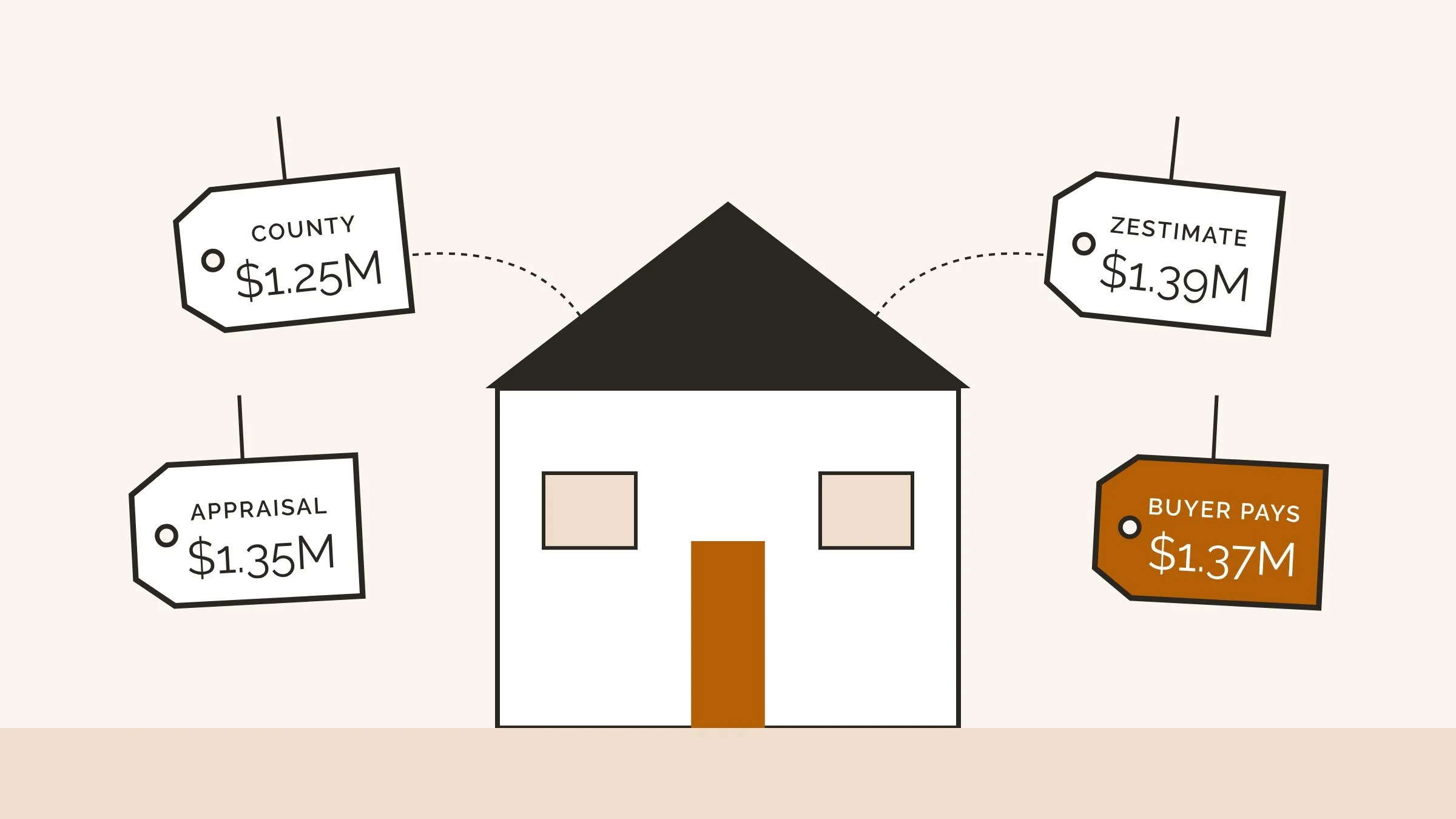
Short answer: Because each value is updated differently, used for a different job, using different data, at a different moment in time.
Real answer: Your county’s assessed value sets your property tax. An appraisal tells a lender how much to lend. Market value is what a buyer pays this month, and Zillow and Redfin are guessing at it.
Home value checker
Which home value counts for you?
Pick your job and county, then type the numbers you have. You’ll see what each one implies, where they overlap and which one counts. An example is loaded. Nothing you enter leaves this page.
Your checklist
County ratios: Washington Department of Revenue, 2025 study for 2026 taxes. The ±15% band is the uniformity standard King County met in the state’s 2024 report. Online range: Zillow’s median miss (1.80% for sale, 7.21% not for sale). A read on the numbers, not an appraisal or a CMA.
Clients send me screenshots of four different numbers for the same house and ask which one is real. All of them are, for their own job. Here’s what each one measures, how far apart they run in Seattle, and which one counts for you.
Same thing, other names: assessed value is also called tax value, taxable value or the county value. Market value is fair market value, or “true and fair value” in state law. Zillow and Redfin estimates are automated valuation models (AVMs). A broker’s value is a CMA, a comparative market analysis.
The basics
The values your home has, and who sets each one
Same house, different jobs
One house carries several numbers at once. Each one answers a different question for a different person.
The county asks what to tax. The lender asks what to lend against. The buyer asks what to pay. The website asks nothing and guesses.
Seeing them disagree is normal. In a fast, mixed market like Seattle, the gaps widen quickly.
County
Assessed value vs market value in King County
Timeframe Valued as of January 1. Notices mail in summer or fall. Taxes on that value are due the next year.
How the county sets it
The county Assessor values every home each year as of January 1, under RCW 84.40.020. In King County, this year’s taxes use last January’s value (King County Assessor).
State law requires 100% of true and fair value (RCW 84.40.030). The county does it in bulk, with sales models by area, not house by house.
An appraiser must look at each property at least once every six years (RCW 84.41.041). In between, statistics move the value.
How close it runs to market
The state checks the county’s work every year. In its ratio study for 2026 taxes, King County’s assessed values averaged 93.6% of market value.
King County: 84.8% at the low (2023 study) and 93.6% in the latest (2025 study, for 2026 taxes). 100% would mean the county value equals market value.
Pierce ran 91.4% and Snohomish 93.5%. Since 2018, King has ranged from 84.8% to 93.6%. On average, the county value runs below market.
That’s the county average. Single homes swing more. The state’s 2024 ratio report shows King met the uniformity standard: most homes within about 15% of the county median ratio.
Newer homes tend to land closer. Older homes, especially with no recent permits, drift further from reality.
What it’s for, and what it isn’t
Use it to understand your property tax and to decide whether to appeal. My King County appeal guide has the deadline and the steps.
Don’t use it to price a home. A higher value also isn’t a dollar-for-dollar higher tax bill, since levies and budgets set the rate.
Lender
Appraised value vs market value
Who orders it and why
An appraisal is a licensed appraiser’s opinion of value, ordered for the lender. It decides how much the bank will lend.
If the appraisal comes in under the price, the buyer covers the gap or the price changes. My low appraisal guide walks through the options.
- Step 1Pick 3+ closed salesSimilar homes, generally within 12 months, as close as possible.
- Step 2Adjust each oneSize, beds, baths, condition, lot, view, parking.
- Step 3ReconcileOne opinion of value, written up for the lender.
- Step 4Lender caps the loanAt the lower of the price or the appraisal.
How an appraiser picks comps
Fannie Mae requires at least three closed comparable sales, generally from the last 12 months (Selling Guide B4-1.3-08). The appraiser then adjusts each one for differences.
In practice, Seattle appraisers lean on sales from the last one to two months, within about a mile. Sometimes we can show them sales up to six months back.
When appraisals lag
Appraisals look backward at closed sales. When prices rise fast, the closed sales haven’t caught up yet.
This is most common at the end of winter. The market thaws after slow November and December sales, and the comps are stale.
A new report, same job
Since November 2, 2026, conventional loans use a redesigned appraisal report, called UAD 3.6 (Freddie Mac). It’s more data, same job.
Buyer
Market value: the only one buyers pay
Set by a buyer, this month
Market value is the price a ready, willing and able buyer agrees to pay a willing seller today. It changes week to week.
It moves with buyer demand, interest rates, inventory, competition and, honestly, emotion and urgency.
Why Seattle averages break down
Seattle’s housing stock makes averages tricky. One block can hold a 1970s condo, a mid-century rambler and an eight-figure new build.
Early this year, a north Seattle house came up at $800,000. Its tax value was about $900,000. My read was about $1.1 million as is. Three numbers, one house, and the list price was the lowest.
That’s why a list price is a strategy, not a fact. My guide to the list price covers how it’s set, and the historical trends post shows how the months differ.
Websites
Zestimate and Redfin Estimate: how close do they get?
How the models work
Zillow and Redfin pull public records, MLS data and recent sales, then let an algorithm fill in the gaps.
They work best on blocks with similar homes, plenty of sales and recent closings. Seattle often offers the opposite.
Redfin, homes not for sale: share within 10% of the sale price
On-market vs off-market
Accuracy depends on whether the home is listed. Zillow’s median miss is 1.80% on homes for sale and 7.21% on homes that aren’t (Zillow).
Redfin reports 1.94% and 7.66% (Redfin). For homes for sale, the models can see the list price. That’s most of the trick.
What “median” hides
Median means half the homes miss by more. Redfin’s own table shows about 4 in 10 off-market estimates miss the sale price by more than 10%.
Where they miss in Seattle
In Seattle, mixed homes on one block confuse the models, so each site lands on a different number. My list price guide shows one that missed by almost $900,000.
Broker
A broker’s value: market value plus strategy
What a CMA weighs
A broker’s value starts with a comparative market analysis, or CMA. It uses closed sales, like an appraisal, and then looks forward.
A strong CMA weighs condition and quality, micro-location, pending and off-market sales, buyer psychology and the competition you’ll face.
Value, then strategy
It isn’t just “what is it worth?” It’s “how do we win from here?”
For sellers, the pricing tactics live in my seller’s guide. For buyers, offer strategy lives in my buyer’s guide.
Your job
Which value counts for your job
| Your job | Assessed | Appraised | Market | Online | CMA |
|---|---|---|---|---|---|
| Property tax | Counts | – | – | No | No |
| Appealing your value | Counts | – | Clue | Clue | Counts |
| Selling | No | Later | Counts | Clue | Counts |
| Buying with a loan | No | Counts | Counts | Clue | Counts |
| Refinancing | No | Counts | – | Clue | – |
| Curious | – | – | Counts | Clue | – |
Owners
For taxes, the assessed value counts. For a sell, keep or remodel decision, market value counts. Check your county record for errors too; my property fraud alert guide shows how to watch it.
Sellers
Market value counts, and buyers set it. A CMA sets your list price; the appraisal only matters later, if your buyer has a loan.
Buyers
The price you agree to is market value. Your lender caps the loan at the appraisal. Underwriting checks the rest (how underwriting works).
Refinancing
The appraisal counts. The lender lends against it, so the county value and the Zestimate don’t matter much here.
FAQ
Frequently asked questions about home values
Is assessed value the same as market value?
No. Assessed value is the county’s mass estimate for taxes, as of January 1. Market value is what a buyer pays today. In King County, assessed values averaged 93.6% of market value in the latest state study.
Is assessed value higher or lower than market value?
Usually lower in Seattle, because values are set as of January 1 of the prior year and models trail the market. A single home can land above market, especially after a price drop.
How close are appraisals to market value?
Usually close, because both lean on recent sales. Appraisals can come in low when prices rise faster than closed sales, most often in late winter and spring.
Do houses usually sell for appraised value?
The appraisal usually supports the price. When it doesn’t, the buyer covers the gap, the seller lowers the price, or they meet in between.
How accurate is the Zestimate?
Zillow reports a 1.80% median miss on homes for sale and 7.21% on homes that aren’t. Half of homes miss by more than that.
Which is more accurate, Zillow or Redfin?
They run close. Redfin reports 1.94% for homes for sale and 7.66% for off-market homes, against Zillow’s 1.80% and 7.21%. Neither replaces a CMA.
Why is my Zestimate so different from my assessed value?
They’re built from different data, on different dates, for different jobs. The county values as of January 1 for taxes; Zillow updates several times a week and guesses at a sale price.
Are you taxed on market value or appraised value?
On the county’s assessed value. In Washington, it’s meant to be 100% of true and fair value as of January 1.
Will a new condo or apartment building next door lower my value?
Usually not in Seattle. It’s a very mixed city, where a $300,000 co-op can sit next to a $3 million house. Condition and the house itself matter more.
Does renting my home on Zillow hurt its sale value later?
It can. Zillow shows the rental history, including rent and price cuts, and buyers notice. If you rent it out before you sell, I’d list the rental somewhere else.
How much does an appraisal cost in Seattle?
Lenders quoted me about $750 under $1 million and $950 above in November 2026, through an appraisal management company. Complex homes can cost more.
How do I find my King County assessed value?
Search your address in King County eReal Property. Your value notice also shows it, with the appeal deadline.
The bottom line
If all these numbers matched, Seattle would be slow, uniform and predictable. It is none of those things.
The only number that ultimately matters is market value at the exact moment you buy or sell. Everything else is a tool for someone else, or something to understand before you waive financing or promise to cover an appraisal gap.
If you’re writing an offer, my buyer’s guide walks through how offers and contingencies work. If you’re selling, my seller’s guide walks through how I set a list price.
Sources
- RCW 84.40.020, assessment as of January 1
- RCW 84.40.030, 100% of true and fair value
- RCW 84.41.041, annual revaluation; physical inspection at least once every six years
- King County Assessor, Residential property taxes, this year’s taxes use last January’s value
- Washington Department of Revenue, Property tax ratios by county, 2025 for 2026 taxes (Jan 14, 2026), King 93.6%, Pierce 91.4%, Snohomish 93.5%
- Washington Department of Revenue, Annual ratio study results, 2018 to 2025, King 84.8% to 93.6%
- Washington Department of Revenue, 2024 Ratio Report, IAAO standards; King met the residential COD standard (under 15%)
- Fannie Mae Selling Guide B4-1.3-08, Comparable Sales (June 4, 2025), at least three closed comps, generally within 12 months
- Freddie Mac, UAD and forms redesign FAQ, UAD 3.6 mandatory for reports submitted on or after Nov 2, 2026
- Zillow, Zestimate accuracy (refreshed Nov 8, 2026), 1.80% on-market, 7.21% off-market; Seattle on-market 1.56%
- Redfin, Redfin Estimate accuracy (updated Nov 14, 2026), 1.94% on-market, 7.66% off-market; 59.38% of off-market within 10%