
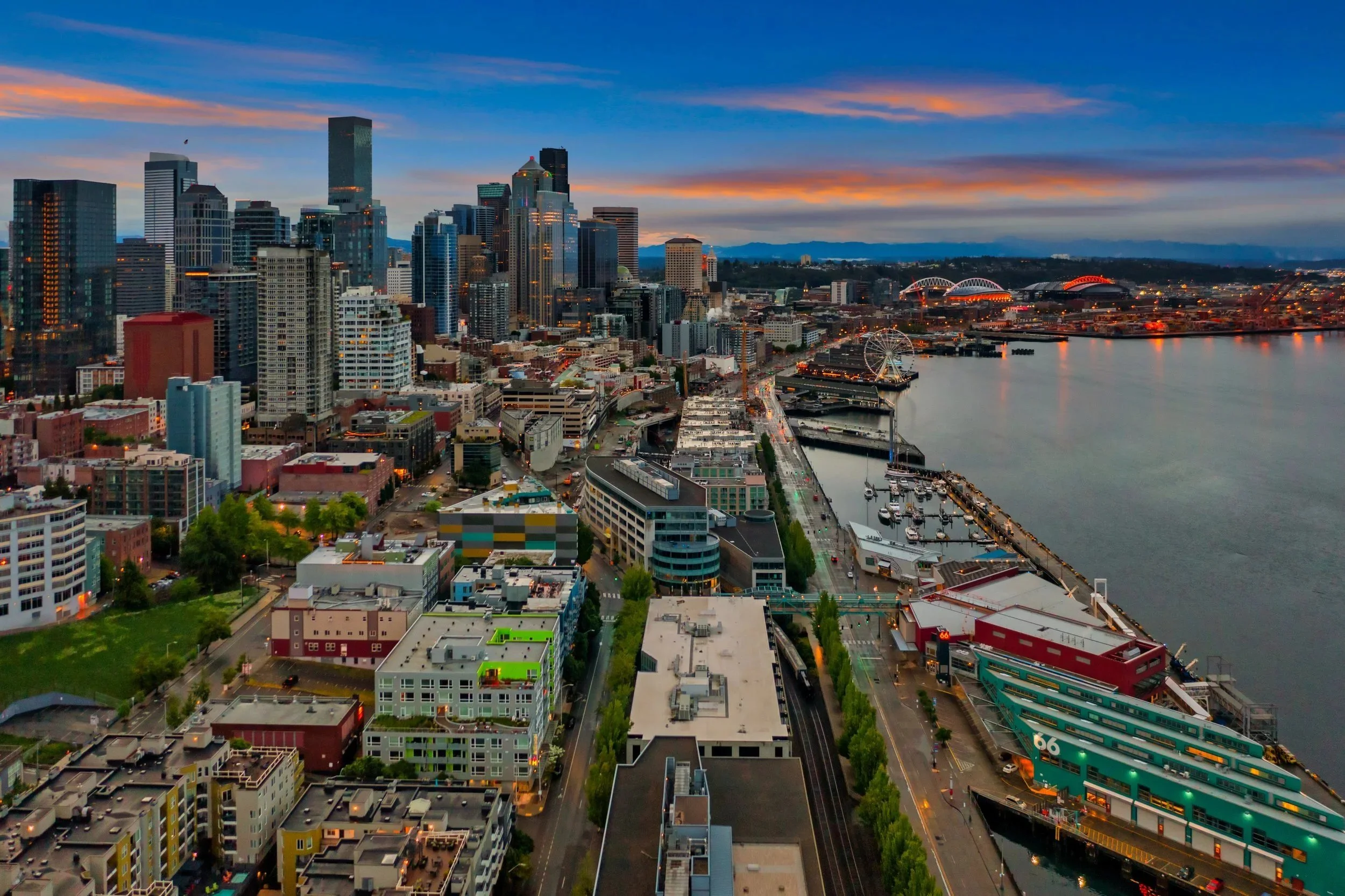
Belltown is the Seattle neighborhood between Pike Place Market and Seattle Center, running from Virginia Street north to Denny Way and from Elliott Bay up to 5th Avenue. In about a mile and a half on foot you can see the free Olympic Sculpture Park, the 1916 Belltown Cottages, the old Film Row on 2nd Avenue, the Moore Theatre and Chief Seattle’s statue at Tilikum Place. Here is how to walk it, the story behind each stop, and what living here is like.
Walk planner
Plan your Belltown walk
A lot of my Belltown client meetings start with coffee at Macrina Bakery on 1st Avenue. This is the walk I suggest afterward: art by the water, two old theaters, a garden hidden among the towers, and a dive bar that has outlasted everything around it.
History
How a hill became Belltown
Belltown sits where a hill used to be. Seattle washed most of Denny Hill into Elliott Bay to open flat land north of downtown, which is why Belltown is the flattest walk in the city center, and why people called it the Regrade for decades.
- Before 1851A Duwamish village called babáqWab stood at the foot of today’s Bell Street.
- 1852William Bell builds a log cabin on his claim, which ran from the water east to about today’s Yale Ave and from Pine St north to Denny Way. The family’s names survive in Bell, Virginia, Olive and Stewart streets.
- 1898–1930The Denny Regrade. Crews lowered Denny Hill in three phases (1898–99, 1903–11 and 1928–30), most of it sluiced into the bay. It was finished December 10, 1930.
- 1920s–60sFilm Row: the major studios run film exchanges and screening rooms along 2nd Ave.
- 1991The Crocodile Cafe opens at 2nd and Blanchard and becomes one of the clubs at the center of Seattle’s early-1990s music scene.
- 2007The Olympic Sculpture Park opens on a former Unocal oil and gas site at the north end of the waterfront.
- 2014–2025Bell Street Park opens (2014), the Alaskan Way Viaduct comes down (2019), Elliott Way links Belltown to the water (2023) and Waterfront Park is finished (September 2025).
The 10 stops
Belltown landmarks, stop by stop
Numbered as they appear on the map above, from the Moore Theatre north and west. All are free to see from outside, any time.
1. The Moore Theatre
2nd Ave and Virginia St · Opened December 28, 1907
James A. Moore built the theater and the hotel beside it for the crowds he expected at the Alaska-Yukon-Pacific Exposition. It opened with a comic opera called The Alaskan and is Seattle’s oldest active theater. It was also the first building on newly regraded 2nd Avenue, which pulled the city’s theater life north.
Tip: The Moore Hotel next door opened eight months before the theater and still takes guests.
2. SIFF Cinema Downtown (the old Cinerama)
4th Ave and Lenora St · Opened January 24, 1963
Built as Martin Cinerama a year after the World’s Fair, it faced demolition by the late 1980s until Paul Allen bought and restored it, reopening it in 1999. The Seattle International Film Festival bought it in 2023 and reopened it on December 14, 2023 under a new name. It is one of the few theaters left that can still show Cinerama.
Tip: Check SIFF’s listings for the rare three-strip Cinerama screenings.
3. Bell Street Park
Bell St from 1st Ave to 5th Ave · Officially opened April 12, 2014
Seattle’s first shared street. Four blocks of Bell Street were raised to one level with no curbs, so people, bikes, buses and cars share a single slow lane lined with planters and seats. Drivers have to turn off after a block. It is the closest thing Belltown, the city’s densest neighborhood, has to a main square.
Tip: Walk it downhill toward the water: Bell Street now ties into Elliott Way and the new waterfront.
4. Film Row: the Rendezvous and Jewelbox Theater
2322 2nd Ave, between Bell and Battery · Jewel Box opened 1932
From the 1920s into the 1960s, 2nd Avenue was Seattle’s Film Row, where the big studios ran film exchanges and theater owners came to preview new releases. B. F. Shearer opened the Jewel Box screening room inside his building, next to the Rendezvous, where movie people ate and made deals. It is the only Film Row screening room left, now a small stage for music, comedy and cabaret.
Tip: Across the street, the 1925 Lorraine Hotel housed visiting movie people. Film Row ran the length of this block.
5. The Austin A. Bell Building
2326 1st Ave · Completed 1890
Austin Americus Bell, the only son of founder William Bell, planned this brick building in 1889 but died before construction began. His widow, Eva, hired architect Elmer Fisher and finished it in his name, with 63 apartments over shops. Fires in 1913 and 1981 gutted it; it was rebuilt behind the old façade in the late 1990s as loft condos.
Tip: Next door is the Barnes Building, which Eva Bell also commissioned.
6. The Crocodile
2505 1st Ave at Wall St · Since April 30, 1991
The Crocodile Cafe opened at 2nd and Blanchard in 1991, just as Seattle’s music scene broke nationally, and became the clubhouse for it. It moved four blocks to this bigger building at 1st and Wall in December 2021, with a showroom, smaller rooms and a hotel upstairs. New owners took over in June 2026 and kept the Seattle staff.
Tip: Check the calendar before you go; some shows are 21 and over.
7. Bell Street Pier rooftop (Pier 66)
2203 Alaskan Way, via the Bell Street pedestrian bridge · Rebuilt and opened 1996
When the Port of Seattle built Pier 66 in 1915, its roof held the city’s first waterfront park. The rebuilt pier opened in 1996 with a cruise terminal, a conference center and Bell Harbor Marina, the only marina downtown, and the public rooftop plaza came back with benches and telescopes.
Tip: The rooftop is open in daylight. Look for cruise ships in season and Mount Rainier on a clear day.
8. Belltown Cottages and P-Patch
Elliott Ave and Vine St · Cottages 1916; garden since 1995
Developer William Hainsworth built a cluster of small Craftsman cottages here in 1916 for waterfront workers. The few that survive are the last wood-frame houses in downtown Seattle, set in a pocket park beside the Belltown P-Patch, a 35-plot community garden with mosaics and a mural among the towers.
Tip: The Cottage Park is open 4 AM to 11:30 PM. The plots belong to the gardeners, so look, don’t pick.
9. Olympic Sculpture Park
2901 Western Ave at Broad St · Opened January 20, 2007
The Seattle Art Museum turned a former Unocal oil and gas site into a free, nine-acre park that runs from the PACCAR Pavilion down to a pocket beach on Elliott Bay. Look for Alexander Calder’s red Eagle, Richard Serra’s Wake, Jaume Plensa’s Echo and Louise Bourgeois’s Father and Son fountain, with the Olympics behind them.
Tip: Open from 30 minutes before sunrise to 30 minutes after sunset. Keep walking north into Myrtle Edwards Park, renovated in 2026.
10. Tilikum Place, Chief Seattle and the 5 Point
5th Ave, Denny Way and Cedar St · Statue unveiled November 13, 1912
James Wehn’s bronze of Chief Seattle, raising his hand in welcome, was Seattle’s first commissioned statue. It was unveiled by Myrtle Loughery, his great-great-granddaughter. Across the little plaza, the 5 Point Cafe has served diner food and drinks since 1929, with the Monorail rumbling past toward the Space Needle.
Tip: The Space Needle and Seattle Center are a block north if you want to keep going.
Plan your day
When to go: the Belltown calendar
| Event | When | What to know |
|---|---|---|
| Belltown Art Walk | Second Friday, 6 to 9 PM | Free, all ages, year-round. Galleries, shops and bars host local artists. Map and venues |
| Olympic Sculpture Park | Every day | Free. Opens 30 minutes before sunrise, closes 30 minutes after sunset. PACCAR Pavilion 9 AM to 4 PM. SAM |
| Summer at SAM | Summer | In 2026 the park added an artist-made nine-hole mini golf course (June 17 to September 7) and free Thursday-evening and Sunday events. |
| Sunset | Any clear evening | The sun drops behind the Olympics across Elliott Bay. The Sculpture Park and the Pier 66 rooftop are the best seats. |
| Shows | Most nights | The Moore, the Crocodile, the Jewelbox and SIFF Cinema Downtown all run evening programs. Crocodile · Moore · SIFF |
Getting there
Getting there and parking
- Light railThere’s no station in Belltown itself. Westlake Station on the 1 Line is a few blocks from the Moore Theatre end of this walk.
- MonorailThe Seattle Center Monorail runs from Westlake Center to Seattle Center, passing over 5th Ave beside Tilikum Place, so you can start at one end and ride back from the other (schedule).
- Bike or walk the waterThe new waterfront bikeway and promenade run along Alaskan Way, and Elliott Way climbs from the waterfront to Bell St at Western and Elliott (City of Seattle). The Elliott Bay Trail continues north through Myrtle Edwards Park.
- CarStreet parking is paid and turns over fast. The Olympic Sculpture Park garage at Broad St and Western Ave is open 6 AM to 11 PM, from $6 for the first hour.
Living here
What it’s like to live in Belltown
Belltown is condo and apartment country. High-rises along 1st, 2nd and Western trade yards for views of the bay, the Olympics and the Space Needle, and everything from Pike Place Market to Seattle Center is a walk. It’s also the densest neighborhood in the city, so the street life comes with the address: bars on 1st and 2nd, events at Seattle Center, cruise days at Pier 66.
For the numbers people ask me about, like demographics, drive times and safety, see my Belltown neighborhood page. Prices right now are on my Seattle market page, and the 10-year month-by-month trends are here on the blog.
- HOA dues cover moreIn the big towers, dues often include water, sewer, garbage, earthquake insurance and a 24-hour concierge, which doubles as security and a safe place for packages. Pools and gyms raise them. Read what yours covers.
- Ask why dues are lowLow dues can mean a building that needs little, or owners who haven’t raised them and may face a special assessment later. The resale certificate and the reserve study tell you which.
- Rental rules vary by buildingSome Belltown buildings allow short stays; others require 30-day, six-month or one-year minimum leases, and some cap the number of rentals. Rules change by owner vote, and a building with too few owner-occupants can be harder to finance.
- Parking is building by buildingMany units come without a space. An assigned or deeded space matters to a lot of buyers here, and to you when you sell.
- Views can changeA tower next door can change a view. A rendering in a sales brochure isn’t a plan; a filing with the city is. You can look up permits for nearby lots through Seattle SDCI.
- Quieter since 2019Before the Alaskan Way Viaduct came down in 2019, you could hear Highway 99 from some west-facing condos. Now the traffic runs in the tunnel, and the waterfront below is a park.
How I check a building before an offer, including dues, reserves, rental rules and views, is in my buyer guide for clients. Curious what one of these homes looks like inside? Here is my most recent Belltown listing.
Neighbors
Belltown vs. Downtown vs. Uptown
Belltown sits between the downtown core and Uptown at Seattle Center. Here is how the three feel different.
| Belltown | Downtown core | Uptown | |
|---|---|---|---|
| Known for | Waterfront art, Film Row, bars and music on 1st and 2nd | Shopping, offices, Pike Place Market | Seattle Center, the Space Needle, Climate Pledge Arena |
| On the water | Olympic Sculpture Park, Pier 66, the Elliott Bay Trail | Waterfront Park and the Seattle Aquarium | A few blocks up from Myrtle Edwards Park |
| Evenings | Restaurants, bars and clubs | Quieter after shops close, busy on event nights | Concerts, games and theater at Seattle Center |
| Homes | Mostly condo towers and apartments | Fewer homes, more hotels and offices | Condos, apartments and older mid-rise buildings |
More neighborhood walks: Fremont and First Hill’s architecture.
FAQ
Frequently asked questions about Belltown
What is Belltown in Seattle known for?
Waterfront art, nightlife and history. It has the free Olympic Sculpture Park, the old Film Row on 2nd Avenue, the 1907 Moore Theatre, the Crocodile music club, Bell Street Park and the Belltown Cottages, all on land that was once Denny Hill.
Where is Belltown, and what are its boundaries?
Just north of downtown Seattle. It runs from Virginia Street (Pike Place Market’s north edge) to Denny Way, and from Elliott Bay up to 5th Avenue, with Seattle Center just beyond Denny Way.
Why is it called Belltown?
For William Nathaniel Bell, one of the 1851 settlers, whose land claim covered it. Bell built a cabin here in 1852, and Bell, Virginia, Olive and Stewart streets carry his family’s names.
What was the Denny Regrade?
The project that leveled Denny Hill. Between 1898 and 1930, in three main phases, crews washed and dug the hill away, mostly into Elliott Bay, finishing on December 10, 1930. That’s why Belltown is flat and why it was long called the Regrade.
What is Bell Street Park?
Seattle’s first shared street: four blocks of Bell Street, from 1st to 5th Avenue, rebuilt with no curbs so walkers, bikes, buses and cars share one slow lane. It officially opened April 12, 2014.
Is the Olympic Sculpture Park free?
Yes, every day. It opens 30 minutes before sunrise and closes 30 minutes after sunset, and the PACCAR Pavilion is open 9 AM to 4 PM. The garage at Broad and Western is paid. Details are on SAM’s site.
What was Film Row in Seattle?
The stretch of 2nd Avenue in Belltown where Hollywood studios kept film exchanges and screening rooms from the 1920s into the 1960s. The Jewelbox Theater inside the Rendezvous, opened in 1932, is the one screening room left.
Is Belltown walkable?
Very. It’s flat, compact and between Pike Place Market and Seattle Center. The only climb is the bluff between 1st Avenue and the waterfront, which has stairs and the Bell Street pedestrian bridge.
Is Belltown safe?
Like any dense downtown neighborhood, it depends on the block and the hour. Walk it at night before you decide, and see my Belltown neighborhood page for crime maps and the numbers.
Is it better to stay in Belltown or downtown?
It depends on your trip. Belltown puts you between Pike Place Market and Seattle Center with restaurants and bars at the door; the downtown core is closer to shopping and the convention center. Both are walkable to the waterfront.
Is Belltown a good place to live?
For people who want to walk everywhere and like city life, yes. Most homes are condos, so dues, rental rules, parking and views matter more than they do in a house. My Belltown page has the neighborhood numbers.
What ZIP code is Belltown?
98121.
The bottom line
Belltown rewards a slow walk. Start at the Moore, follow 2nd Avenue’s old Film Row, cut down Bell Street to the water, and finish at the Sculpture Park at sunset. If you’re thinking about living here, come back on a Friday night and a weekday morning: you’ll know quickly if it’s your Seattle.
Sources
- Belltown walking tour, HistoryLink.Tours
- Seattle's Denny Regrade is completed after 32 years on December 10, 1930, HistoryLink
- Denny Regrade (Seattle), HistoryLink
- Moore Theatre (Seattle), HistoryLink
- Seattle's Film Row and its Rendezvous Cafe and Jewel Box Theater, HistoryLink
- Austin A. Bell Building, HistoryLink
- Austin A. Bell Building stop, HistoryLink.Tours
- Belltown P-Patch and Cottage Park, HistoryLink.Tours
- Belltown P-Patch, Seattle Department of Neighborhoods
- Olympic Sculpture Park opens, January 20, 2007, HistoryLink
- Olympic Sculpture Park: hours and visiting, Seattle Art Museum
- Bell Street Park shared street, NACTO
- Seattle Central Waterfront, Part 9: Bell Street Pier and vicinity, HistoryLink
- Hidden in plain sight: gems of Bell Street Pier, Port of Seattle
- City of Seattle's Civic Art Collection, Part 1, HistoryLink
- Tilikum Place, Seattle Parks and Recreation
- The 5 Point Cafe, Wikipedia
- History, The Crocodile
- A new chapter for The Crocodile (June 8, 2026), The Crocodile
- Cinerama is saved: SIFF acquires historic theater, GeekWire
- SIFF Cinema Downtown, Cinema Treasures
- Alaskan Way and Elliott Way, City of Seattle
- Leaders celebrate the completion of Waterfront Park, Office of the Mayor
- Myrtle Edwards Park: from grass to great, Seattle Parks and Recreation
- Seattle art walks, SEAtoday
- Seattle Art Museum tees up summer, Seattle Magazine
- Belltown, Seattle, Wikipedia